


Homeowners insurance is one of those things most people pay for without fully understanding. The premium gets deducted, the policy sits in a drawer, and most policyholders assume they are “covered” — until something happens and they discover the gap between what they assumed and what the policy actually says.
This guide explains every major component of a standard homeowners policy, what each one actually pays for, and — just as importantly — what it does not.
How a Standard Homeowners Policy Is Structured
The most common homeowners policy in the United States is the HO-3, an open-perils policy for the dwelling and named-perils coverage for personal property. Most lenders require at least this level of coverage for mortgaged properties.
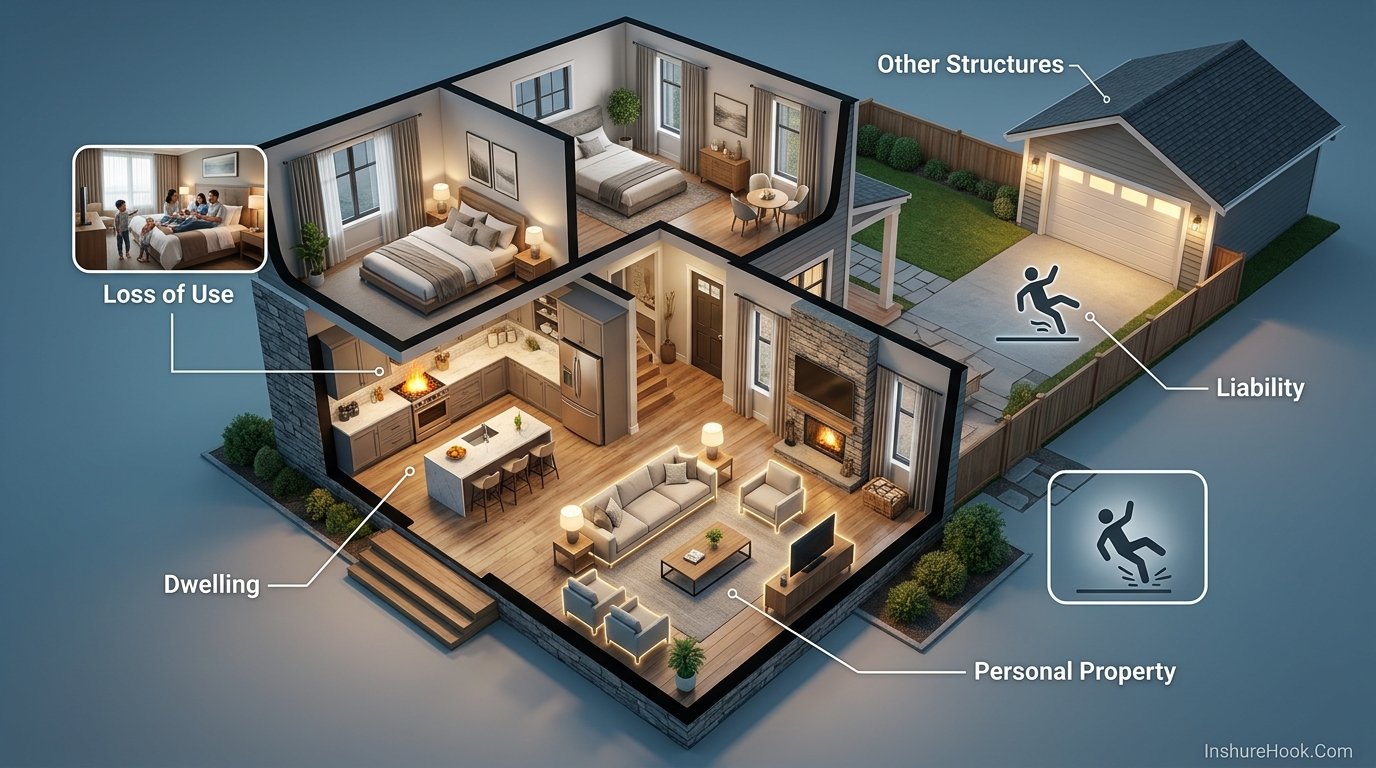
The policy is divided into six coverage components, each identified by a letter:
- Coverage A — Dwelling
- Coverage B — Other Structures
- Coverage C — Personal Property
- Coverage D — Loss of Use
- Coverage E — Personal Liability
- Coverage F — Medical Payments to Others
Each component covers a different category of loss. Understanding what sits in each bucket tells you what your policy actually does when something goes wrong.
Coverage A — Your Home’s Structure
Coverage A is the core of any homeowners policy. It pays to repair or rebuild the physical structure of your home — walls, roof, floors, built-in appliances, plumbing, electrical systems, HVAC — when damage results from a covered peril.
On an HO-3 policy, Coverage A operates on an open-perils basis, meaning it covers all causes of loss except those specifically excluded. The exclusions are what matter most here.
Covered under Coverage A (open perils — examples):
- Fire and smoke damage
- Wind and hail damage
- Lightning strikes
- Explosion
- Vandalism and malicious mischief
- Theft of structural components
- Falling objects (trees, ice, aircraft)
- Weight of ice, snow, or sleet
- Sudden water damage from burst pipes or appliance overflow
- Damage from vehicles or aircraft
Explicitly excluded under most standard policies:
- Flood damage — requires a separate flood insurance policy through the National Flood Insurance Program or a private insurer
- Earthquake damage — requires a separate earthquake endorsement or policy
- Gradual deterioration and wear and tear
- Mold resulting from long-term moisture or neglect (though mold from a sudden covered event may qualify — the does home insurance cover mold guide explains the distinction)
- Sewer backup (available as an endorsement on many policies)
- Pest damage — termites, rodents, insects
- Intentional damage by the policyholder

How your Coverage A limit is set:
This is where many homeowners are underinsured without realizing it. Coverage A should reflect the replacement cost of your home — what it would cost to rebuild it from the ground up using current materials and labor costs — not its market value or purchase price.
These figures are often very different. A home purchased for $350,000 in a particular market might have a replacement cost of $420,000 due to local construction costs. A home with a high market value in a desirable area might have a lower replacement cost because the land value is not insured.
Reviewing your dwelling coverage limit annually — particularly in markets where construction costs have increased significantly — is one of the most practical things a homeowner can do. Your insurance declaration page shows your current Coverage A limit. If it has not been updated in several years, it may not reflect current rebuild costs.
Coverage B — Other Structures
Coverage B covers structures on your property that are not attached to the main dwelling — detached garages, garden sheds, fences, swimming pool enclosures, gazebos, and similar.
The standard limit is typically 10 percent of your Coverage A amount. If your home is insured for $400,000, your other structures coverage is $40,000. For most homeowners, this is sufficient. If you have significant outbuildings — a large workshop, a guest cottage, a pool house — reviewing this limit separately is worthwhile.
Coverage C — Personal Property
Coverage C pays for your belongings — furniture, clothing, electronics, kitchenware, sports equipment, jewelry, and other personal items — if they are damaged or stolen due to a covered peril.
Unlike Coverage A, personal property coverage on an HO-3 operates on a named-perils basis, meaning it only covers losses caused by the specific events listed in the policy. The list is long — typically 16 named perils — but it excludes some causes that the dwelling coverage would include.
Two coverage approaches: ACV vs. RCV
This distinction has a real financial impact:
Actual Cash Value (ACV) pays what your belongings are worth today — accounting for depreciation. A five-year-old television that cost $800 new might have an ACV of $200. That is what you receive.
Replacement Cost Value (RCV) pays what it costs to buy a new equivalent item today. The same television would generate a payment closer to current retail price for a comparable model.
Most standard policies default to ACV for personal property. Upgrading to RCV coverage costs more in premium but produces meaningfully higher payouts when a significant loss occurs. For households with newer electronics, quality furniture, or other items that depreciate quickly, the upgrade is often worth considering.

Special limits on high-value items:
Standard policies cap coverage on certain categories regardless of your overall Coverage C limit:
| Category | Typical Sublimit |
|---|---|
| Jewelry and watches | $1,000 – $2,500 |
| Firearms | $2,000 – $2,500 |
| Cash and precious metals | $200 – $500 |
| Securities and documents | $1,000 – $2,500 |
| Silverware | $2,500 |
| Electronics used for business | $1,500 |
| Watercraft and equipment | $1,000 – $1,500 |
If you own items that exceed these sublimits — an engagement ring, a gun collection, fine jewelry, musical instruments — a scheduled personal property endorsement (also called a floater) provides additional coverage specifically for those items, often with no deductible and broader coverage including mysterious disappearance.
For a complete breakdown of how personal property coverage works and how to evaluate whether your limits are adequate, this personal property coverage guide covers the mechanics in detail.
Coverage D — Loss of Use
If your home becomes uninhabitable due to a covered loss, Coverage D pays for the additional living expenses you incur while displaced. This includes:
- Hotel or temporary rental costs above what you normally pay for housing
- Restaurant meals above your normal food budget (because you cannot cook at home)
- Laundry costs, pet boarding, and other reasonable additional expenses directly caused by the displacement
The key word is additional. Coverage D does not reimburse your normal living expenses — it covers the amount above what you would have spent anyway.
Coverage D limits are typically set at 20 to 30 percent of your Coverage A amount, though this varies by insurer. Keep receipts for every expense during displacement — documentation is required for reimbursement.
One important detail: Coverage D activates when the home is uninhabitable due to a covered loss. If the reason your home is uninhabitable is an excluded peril — a flood when you have no flood insurance, for example — Loss of Use does not apply.
The loss of use coverage guide explains what qualifies, what documentation you need, and how the claims process works for this specific coverage.
Coverage E — Personal Liability
Personal liability coverage protects you financially if you are held legally responsible for bodily injury or property damage to others. It covers:
- A guest who slips on your icy walkway and breaks a wrist
- A visitor’s child who is bitten by your dog
- A contractor injured while working at your home under certain circumstances
- Accidental damage you cause to a neighbor’s property
- Legal defense costs if you are sued — even if the lawsuit is ultimately dismissed
Coverage E pays both your legal defense costs and any damages awarded, up to your liability limit. Standard policies start at $100,000, but many insurance professionals recommend carrying at least $300,000 to $500,000. The premium difference between $100,000 and $300,000 of liability coverage is often modest — a few dollars per month.

For households with elevated liability exposure — a swimming pool, a trampoline, a dog breed with a bite history, frequent guests — reviewing liability limits carefully is important. An umbrella insurance policy provides an additional layer of liability protection above your homeowners (and auto) limits, typically in increments of $1,000,000, for a few hundred dollars per year.
Coverage F — Medical Payments to Others
Coverage F pays for minor medical expenses of guests injured on your property, regardless of fault. If a neighbor’s child trips on your front step and needs stitches, Coverage F pays their medical bills up to the limit — without requiring a liability claim or fault determination.
Standard limits run from $1,000 to $5,000. This is a goodwill coverage — it handles small injuries quickly and without the friction of a full liability claim. It does not cover your own household members’ injuries, which fall under health insurance.
What Homeowners Insurance Does NOT Cover
Understanding exclusions is as important as understanding coverage. The most significant gaps in a standard HO-3 policy:
Flooding. No standard homeowners policy covers flood damage — water that enters from ground level due to storm surge, river overflow, or heavy rain runoff. This is one of the most financially devastating and most misunderstood gaps. The National Flood Insurance Program (NFIP) and private flood insurers offer separate policies. According to FEMA, more than 20 percent of flood claims come from properties outside high-risk flood zones.
Earthquakes. Separate earthquake coverage is required. This is particularly relevant in California, the Pacific Northwest, parts of the Midwest near the New Madrid fault, and anywhere with meaningful seismic activity.
Maintenance and wear and tear. Your policy is not a home warranty. Mechanical breakdown, gradual deterioration, rust, rot, and ongoing neglect are not insured events. A pipe that corrodes slowly over years and eventually leaks is maintenance. A pipe that freezes and bursts suddenly is a covered peril. The difference between the two — sudden vs. gradual — is the line the insurer draws.
Sewer and drain backup. Water backing up from a sewer or drain is excluded from most standard policies. It is available as an endorsement on many policies for a modest additional premium and is worth considering for homes with older plumbing or basement drains.
Business activity. If you operate a business from your home, standard Coverage C limits for business property and equipment are very low — typically $2,500 or less. A homeowners business endorsement or separate business owners policy is needed for meaningful business property and liability coverage.
High-value items above sublimits. As described in the Coverage C section, standard policies cap payouts on jewelry, firearms, cash, and other categories well below what many households actually own.
Policy Types: HO-3, HO-5, and Others
The HO-3 is the standard, but not the only option.
HO-5 (Comprehensive Form) provides open-perils coverage for both the dwelling and personal property — the broadest protection available in the standard homeowners market. It also typically provides higher default sublimits for valuable items and fewer restrictions on water damage coverage. HO-5 premiums run 10 to 20 percent higher than comparable HO-3 policies. For homeowners with newer homes, higher-value contents, or a desire for broader protection, the difference can be worthwhile.
HO-4 (Renters Insurance) covers personal property and liability for tenants. The structure is the landlord’s responsibility.
HO-6 (Condo Insurance) covers the interior of a condominium unit and personal property. The condo association’s master policy covers the building exterior and common areas.
HO-8 (Older Home Form) is designed for older homes where replacement cost coverage is not practical because rebuilding to original specifications would be prohibitively expensive. It provides more limited coverage on an ACV basis.
Endorsements That Fill Common Gaps
A base homeowners policy leaves specific gaps that endorsements address. Common and useful additions:
Scheduled personal property endorsement — Provides itemized, agreed-value coverage for high-value items above the standard sublimits. Required for any jewelry, art, collectibles, or instruments worth more than the policy’s sublimits.
Water backup and sump overflow endorsement — Covers damage from backed-up sewers or drains and sump pump failure. This is a meaningful risk for homes with basements and is typically inexpensive to add.
Equipment breakdown endorsement — Covers sudden mechanical breakdown of home systems and appliances due to electrical or mechanical failure — bridging a gap between homeowners insurance (which excludes wear and tear) and a home warranty. Coverage applies to events like a power surge frying your HVAC control board.
Inflation guard endorsement — Automatically adjusts your Coverage A limit annually to keep pace with construction cost increases. Without this, your dwelling coverage can fall below replacement cost as inflation raises rebuild costs.
Identity theft endorsement — Covers costs associated with restoring your identity after theft, including legal fees, lost wages, and credit monitoring.

For a broader explanation of how endorsements modify your base policy, this insurance endorsement guide explains how each type works and when adding one makes sense.
How Much Coverage Do You Actually Need?
Dwelling (Coverage A): Should equal the full replacement cost of your home — not market value. Many insurers provide a replacement cost estimator during the application process. If yours has not been updated recently, request a current estimate.
Personal property (Coverage C): Complete a home inventory — a room-by-room list of your belongings with estimated values. This exercise almost always reveals that people own more than they realize. Free home inventory apps and spreadsheet templates make this manageable. The Insurance Information Institute recommends documenting serial numbers and photographing valuable items.
Liability (Coverage E): At minimum, $300,000. Higher if you have a pool, trampoline, dog, or host frequent gatherings. Umbrella coverage is worth considering at that point.
Deductible: Higher deductibles reduce premiums but increase out-of-pocket exposure per claim. The home insurance deductible guide covers how to evaluate this tradeoff honestly.
Frequently Asked Questions
It depends on what caused the damage. Sudden damage from wind, hail, or a falling tree is typically covered. A roof that has simply worn out over time and reached the end of its useful life is a maintenance issue and is not covered. Some insurers also apply depreciation to older roofs — paying a percentage of replacement cost based on the roof’s age and remaining useful life rather than the full replacement cost.
Personal belongings stolen from your vehicle are covered under your homeowners policy’s Coverage C (personal property), not your auto policy. Your auto policy covers damage to the vehicle itself. The homeowners deductible applies, and coverage is subject to any applicable sublimits for the stolen items.
Damage your pet causes to your own property is generally not covered — that is wear and tear. If your pet causes injury to a guest or damages someone else’s property, Coverage E (liability) may respond depending on your policy’s specific terms and your state’s dog bite laws. Some insurers exclude certain dog breeds from liability coverage. Check your policy’s exclusions specifically.
Business equipment used for work purposes is covered only up to the very low standard sublimit (typically $2,500). If you work from home with valuable equipment or have clients visiting, a home business endorsement or separate business owners policy provides meaningful coverage. Standard Coverage E also excludes liability arising from business activity.
An umbrella policy provides excess liability coverage above your homeowners and auto liability limits — typically in $1,000,000 increments. It kicks in when a claim exceeds your underlying policy limits. Annual premiums typically range from $150 to $400 for $1,000,000 of coverage. For households with meaningful assets to protect, it is one of the most cost-effective forms of insurance available.
The full home insurance claims process is covered in a dedicated guide, but the short answer: document everything first, notify your insurer promptly with your policy number, and do not make permanent repairs before the adjuster inspects.
Disclaimer: This article is intended for general educational purposes only and does not constitute legal, financial, or insurance advice. Coverage terms, exclusions, sublimits, and policy options vary significantly by insurer, policy type, and state. Information reflects general industry practices as of June 2026. Always review your specific policy documents and consult a licensed insurance professional in your state for guidance tailored to your situation.
Written by Imran Ahmad, content writer specializing in insurance education | InsureHook.com
Content reviewed against publicly available industry sources. Readers should verify current coverage terms and limits directly with their insurer or a licensed professional.
Sources: Insurance Information Institute (iii.org), National Association of Insurance Commissioners (naic.org), FEMA National Flood Insurance Program (fema.gov/flood-insurance)
