



Many consumers focusing on building structure buy homeowners insurance. Structures include walls, roofs, and foundations. However, a large part of your homeowners insurance policy protects everything in your home including your furniture, electronics such as your laptop or your child’s bike stored in the garage.
Personal property coverage home insurance pays for your belongings if they are damaged or destroyed, or stolen. Although this coverage may seem simple and straightforward, its details are where most policyholders actually get surprised.
What Personal Property Coverage Actually Is
Personal property coverage is formally labeled Coverage C in a standard homeowners policy. It applies to your movable possessions. Think furniture, clothing, electronics, kitchen appliances, sporting equipment, tools, and books. Basically anything that would move with you if you packed up and left.
What surprises most people is how much they actually own. Walk through your home and add it up mentally. A living room alone can hold $20,000 to $35,000 in furniture and electronics. Add clothing, hobby gear, kitchen equipment, and garage tools and that number climbs fast. Most homeowners dramatically underestimate this figure when choosing a coverage limit.
Coverage C also typically protects your belongings when they are away from your home. Your laptop stolen from a coffee shop. Your luggage taken from a hotel room. Your camera damaged on a trip. Your homeowners policy may respond to those losses too. The limits and conditions vary by insurer and state.
Where Personal Property Coverage Appears in Your Policy
Most standard policies are built on the ISO HO-3 form or a variation of it. Coverage C sits alongside:
- Coverage A: Dwelling (the physical structure)
- Coverage B: Other structures (detached garage, fence)
- Coverage C: Personal property (your belongings)
- Coverage D: Loss of use (living expenses if you’re displaced)
Understanding this structure helps you see that your home policy is really four protections bundled together. If you want to understand how loss of use coverage works when you’re forced out of your home, that’s a separate but related piece worth knowing.
The Two Payout Methods That Change Everything
This is the most important concept in personal property coverage. Most policyholders don’t realize there are two fundamentally different ways their insurer can calculate a claim payout.
Actual Cash Value vs. Replacement Cost Value
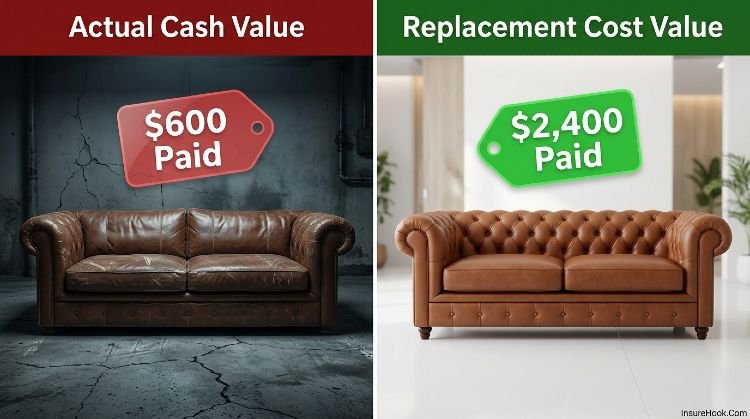
Actual Cash Value (ACV) pays what your item is worth today after depreciation. Replacement Cost Value (RCV) pays what it costs to buy a comparable item at today’s prices.
The gap between those two numbers can be enormous.
| Coverage Type | How It Calculates the Payout | Real Example: 6-Year-Old Laptop ($1,200 New) |
|---|---|---|
| Actual Cash Value | Subtracts depreciation from original value | May pay $300 to $400 |
| Replacement Cost Value | Pays current market replacement cost | Pays $900 to $1,100 |
| Scheduled Item Endorsement | Pays agreed or appraised value | Pays full scheduled amount |
A six-year-old sofa that cost you $2,500 might net you $700 under ACV. That same sofa costs $2,800 to replace today. The difference comes entirely out of your pocket.
Replacement cost coverage costs more in monthly premiums. But for most households the premium difference is modest relative to what you stand to recover after a significant loss.
One of the most overlooked decisions in a homeowners policy is the choice between actual cash value and replacement cost for personal property. Policyholders frequently don’t discover they have ACV coverage until a claim is filed and the payout is far lower than they expected. At that point there is nothing the agent can do.
Which One Should You Choose?
Replacement cost coverage is almost always the better choice for most households. The main exception is if your belongings are older and you plan to replace them anyway. Even then, the payout difference usually justifies the higher premium.
Check your declarations page. It will state whether your Coverage C uses ACV or RCV. If it shows ACV and you want RCV, contact your insurer. Most companies offer the upgrade as an endorsement.
What Standard Policies Cover and What They Don’t
A standard homeowners policy covers personal property against named perils. This means only specific events listed in the policy trigger coverage. Common covered perils include:
- Fire and smoke
- Theft and vandalism
- Windstorm and hail
- Weight of ice or snow
- Burst pipes and sudden water damage
- Lightning strikes
- Falling objects
Flood damage is not covered. Earthquake damage is not covered. Those require completely separate policies. If you live in a flood-prone area, the National Flood Insurance Program offers coverage that your homeowners policy will not provide.
Special Dollar Limits on High-Value Categories
Here is where many people discover they are significantly underinsured.
Even if your total Coverage C limit is $150,000, your insurer places internal caps on specific item categories. These sublimits apply regardless of your total coverage amount.
| Item Category | Typical Sublimit for Theft | Notes |
|---|---|---|
| Jewelry and watches | $1,500 | One of the most common surprises at claim time |
| Firearms | $2,500 | May vary by insurer |
| Cash and gift cards | $200 | Almost universally capped low |
| Fine art and collectibles | $2,500 | Appraisal often required for scheduling |
| Musical instruments | $2,500 | Varies widely by insurer |
| Business property at home | $2,500 | Home-based business equipment often excluded entirely |
| Silverware and goldware | $2,500 | Theft-specific sublimit |
If you own valuable jewelry, a wine collection, high-end camera gear, or antiques, a standard policy will not fully cover those items. A personal property endorsement or separate floater policy lets you schedule individual items at their full appraised value.
How Your Coverage Limit Gets Set
Personal Property Value Estimator
Estimate your belongings value room by room
Step 1 of 3 — Room by Room Estimate
Drag each slider to match the estimated total value of belongings in that room. Include furniture, electronics, and decor.
Most insurers set Coverage C as a percentage of your dwelling coverage. The default is typically 50% to 70% of your Coverage A limit.
If your home is insured for $400,000, your personal property coverage might automatically be $200,000 to $280,000. That sounds substantial. But the real question is whether that number reflects what you actually own.
Take Priya, a homeowner in Austin, Texas. She had a $180,000 personal property limit. After a kitchen fire spread through her first floor, she filed a claim expecting to recover most of her losses. Her policy used actual cash value. Her guitar collection valued at $14,000 hit a $2,500 sublimit. Her jewelry payout fell far short of replacement cost. The total gap between what she recovered and what she lost exceeded $28,000. Nothing about that outcome was the insurer’s fault. The policy paid exactly what it was written to pay. Priya just never matched her coverage to her actual possessions.
This is a pattern claims professionals see repeatedly.
Building a Home Inventory Before You Ever Need It
A home inventory is the single most practical thing a homeowner can do to protect a personal property claim. Very few people actually do it.
The concept is simple. Document what you own now so you can prove it later. Walk through each room. Photograph or video your belongings. Note brand names, model numbers, and purchase prices for high-value items. Keep receipts when you can.
The Insurance Information Institute offers guidance on building and maintaining a useful inventory. The home insurance claims process becomes far more efficient when you arrive with documentation instead of trying to reconstruct your losses from memory after a traumatic event.
Store your inventory in cloud storage or a secure app. Keeping it only on a home computer that could be destroyed in the same fire defeats the purpose.

What to Record for Each Valuable Item
For high-value belongings specifically, go beyond a photo:
- Purchase date and original price
- Current estimated replacement value
- Brand, model, and serial number
- Receipts or professional appraisals
- Any scheduled endorsement policy number
This level of detail matters most for items approaching or exceeding their sublimit thresholds.
Off-Premises Coverage: Your Belongings Beyond Your Front Door
Standard personal property coverage usually follows you. If your bicycle is stolen from a trailhead parking lot, your luggage is taken from a hotel room, or your camera is damaged at a sporting event, your homeowners policy may respond.
The important detail is that off-premises coverage typically applies at a reduced limit. Many policies cap this at 10% of your total Coverage C limit. If your personal property coverage is $160,000, off-premises coverage might max out at $16,000.
For college students, most policies extend personal property coverage to belongings kept in a campus dormitory. A student living in an off-campus apartment is typically excluded. That student needs their own renters insurance policy to cover their possessions.
Renters Insurance and Personal Property: The Same Coverage, Different Context
Renters don’t own the building. But they absolutely own everything inside it.
A landlord’s policy protects the physical structure. It does nothing for a tenant’s furniture, clothing, electronics, or appliances. Renters insurance is built primarily around Coverage C. It works on the same principles. The same ACV versus RCV distinction applies. The same sublimits apply. The same inventory need applies.

The premiums are generally low. But the limit you select matters just as much for renters as it does for homeowners. Choosing a $20,000 limit when you own $60,000 in belongings leaves a real gap.
You can explore the broader comparison between personal property coverage options if you want to dig further into how limits and endorsements work together.
Deductibles and When Filing a Claim Makes Sense
Your deductible applies to every personal property claim you file. A $1,500 deductible means the first $1,500 of any loss comes from your pocket.
For a stolen bicycle worth $800, filing a claim nets you nothing after the deductible. You also risk a potential premium increase. For smaller losses, paying out of pocket often makes more financial sense than filing.
For larger losses like a house fire that destroys an entire room of belongings, filing is clearly appropriate. Understanding the relationship between your deductible and your potential payout is part of managing your coverage intelligently. This deductible guide breaks down how that math affects your real costs.
When to Review and Update Your Coverage
Most policyholders set their coverage limits once and never revisit them. That creates a quiet gap that grows larger over time.
Situations that warrant a coverage review:
- You bought significant new electronics or appliances
- You received jewelry, art, or collectibles as gifts or inheritance
- You started working from home with business equipment
- You renovated and added high-end fixtures or appliances
- You got married or had a significant household change
- Inflation has pushed replacement costs higher than your current limit reflects
Insurance laws, coverage requirements, and policy forms vary by state. Coverage that is standard in one state may work differently in another. Always review your actual policy documents and speak with a licensed agent in your state for guidance specific to your situation.
If you want to understand what the broader homeowners policy covers beyond just belongings, this overview of standard homeowners coverage is a practical starting point.
Factors That Affect Your Personal Property Premium
| Factor | Effect on Premium |
|---|---|
| Replacement cost vs. actual cash value | RCV increases premium but significantly improves payouts |
| Total Coverage C limit chosen | Higher limits mean higher cost |
| Deductible amount | Higher deductible lowers premium |
| Scheduled endorsements for valuables | Adds cost proportional to item value |
| Home location and local theft rates | Higher-risk areas generally cost more |
| Security systems and deadbolts | Often qualify for premium discounts |
| Claims history | Prior claims can increase rates |
Managing your premium without sacrificing coverage requires understanding which of these levers you can control. Some homeowners find meaningful savings by adjusting their premium structure without reducing their actual protection.
FAQs
Generally yes. Belongings stored in detached structures are typically covered under Coverage C. Some policies apply a reduced sublimit for items kept in structures other than the main dwelling. Confirm the specifics in your declarations page.
No. Standard policies cover the named insured and resident family members. A roommate who is not a named insured needs their own renters policy. Adding a roommate as a named insured has its own complications. Ask your insurer before assuming anything.
Your insurer pays up to your policy limit. Anything above that comes from your own funds. If your limit is $90,000 and your actual loss totals $130,000, you absorb the $40,000 difference. This is why setting an accurate limit from the start matters.
Yes. A scheduled personal property endorsement lets you list specific items by description and appraised value. This removes the standard sublimit and often covers a broader range of causes of loss including accidental breakage.
Most policies extend Coverage C to belongings kept in a campus dormitory. Students living in off-campus apartments are usually not covered under the parent’s policy. Those students need separate renters insurance.
Replacement costs rise over time. A limit that was adequate three years ago may now fall short because the same items cost more to replace today. Review your Coverage C limit annually and adjust it if your possessions or their replacement costs have increased.
This article is provided for general informational purposes only. It does not constitute insurance advice or guarantee of any specific coverage outcome. Policy terms, coverage details, and state regulations vary significantly across insurers and jurisdictions. Always read your full policy documents carefully and consult a licensed insurance professional in your state before making coverage decisions.
