


Coverage terms vary by state and insurer. Always consult a licensed insurance professional before making coverage decisions.
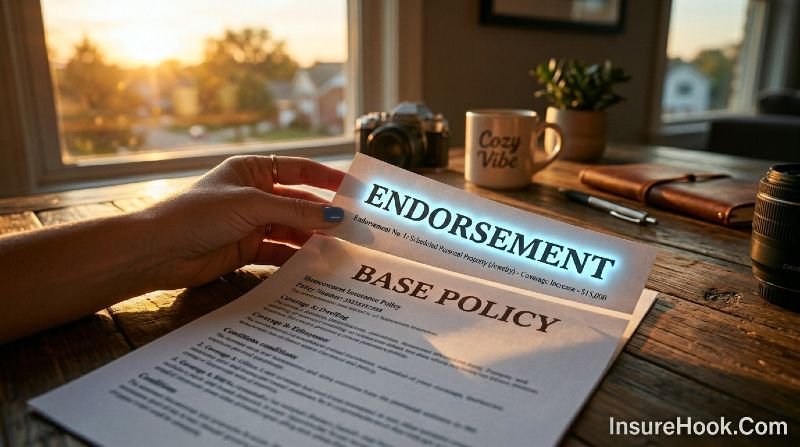
An insurance endorsement is a written modification attached to your existing policy. It officially changes your coverage terms without requiring a completely new policy. The endorsement becomes part of your policy once your insurer issues and approves it. It carries the same legal weight as the original document.
Most people only discover endorsements after a claim gets denied. That tends to be the wrong time to learn about them.
What Does an Insurance Endorsement Actually Do?
The base policy your insurer writes covers a broad category of risk. A standard homeowners policy typically covers the structure, personal belongings, and liability. But it cannot anticipate every household situation, profession, or high-value item you own.
Endorsements help close that gap. Depending on your policy and carrier, they may:
- Add coverage your base policy excludes
- Remove coverage you no longer need
- Raise or lower specific coverage limits
- Change named insureds on the policy
- Clarify ambiguous language in the base form
One detail worth knowing: when an endorsement conflicts with base policy language, the endorsement generally takes precedence. That said, policy interpretation can vary by carrier and state. Reading your full policy packet is the only way to confirm what applies to your situation.
Learning how to read an insurance policy helps you locate where endorsements sit within that document stack and what each form number means.
Common Types of Insurance Endorsements in 2026
Scheduled Personal Property Endorsement
Standard homeowners and renters policies often place sublimits on high-value items like jewelry, fine art, cameras, and musical instruments. Sublimit amounts vary by carrier and state. A scheduled personal property endorsement lists specific items individually. Each item gets its own agreed coverage amount based on a recent appraisal or purchase receipt.
Anonymized example: A photographer carried a renters policy with a standard personal property limit. Her camera equipment was worth significantly more than the policy’s electronics sublimit. Without a scheduled endorsement, a theft claim would have been paid only up to that sublimit. With the endorsement in place, each piece of equipment was itemized and covered at its appraised value.
This endorsement type typically adds cost to your premium. The amount depends on the total appraised value of listed items and your carrier’s pricing. Request a current appraisal before scheduling high-value property.
Water Backup Endorsement
Standard homeowners policies commonly exclude damage from sewer or drain backup and sump pump failure. This endorsement adds that coverage back. It is among the more frequently purchased add-ons in areas with aging municipal infrastructure.
Coverage limits and pricing vary by carrier and state. Check with your insurer about which specific scenarios are included under their form.
Business Pursuits Endorsement
Standard homeowners policies generally exclude business-related liability and equipment losses that occur on your property. If clients visit your home for work purposes or you use expensive equipment for paid work, this gap can be significant.
A business pursuits endorsement may extend limited protection for certain home-based business activities. Coverage scope varies widely by insurer and state. This endorsement is generally not a substitute for a dedicated business owner’s policy in most situations.
Inflation Guard Endorsement
This endorsement automatically adjusts your dwelling coverage limit each year based on local construction cost changes. It helps reduce the risk of your insured value falling behind your home’s actual rebuild cost over time.
Construction costs have shifted across U.S. markets in recent years. According to the U.S. Bureau of Labor Statistics, construction input prices saw notable increases between 2020 and 2024. This endorsement has become more relevant for homeowners who have not recently reviewed their dwelling limits.
Service Line Endorsement
Some carriers offer endorsements covering underground utility lines connecting your home to the municipal supply. These lines are often the homeowner’s financial responsibility when they fail. Availability varies by carrier and region.
Named Endorsements vs. Manuscript Endorsements
Most endorsements you encounter are named endorsements. Insurers pre-draft these on standardized forms approved by state regulators. The language is consistent across policyholders who carry that same form.
Manuscript endorsements are custom-written for a specific policyholder’s situation. They are uncommon in personal insurance lines. You are more likely to see them in large commercial policies where a business has unusual risk characteristics that standard forms cannot address.
“Endorsements are where the real coverage conversation happens. The base policy sets the floor. Endorsements define the ceiling for most policyholders. Skipping that conversation is one of the most common ways people end up underinsured without realizing it.”
Licensed Property & Casualty Insurance Professional
🏆 15+ Years | Personal & Commercial Lines Experience
Do Endorsements Change Your Premium?
Sometimes yes. Sometimes no.
Endorsements that add coverage typically add cost. The exact amount depends on the type of coverage being added, the value of what you are insuring, your location, and your carrier’s pricing model. There is no universal figure.
Endorsements that remove coverage or make administrative updates often carry no premium change. Some may slightly reduce your cost.
Understanding how endorsements interact with your overall premium structure is easier when you know how fixed and variable premiums work in standard insurance pricing.
Where Endorsements Appear on Your Policy Documents
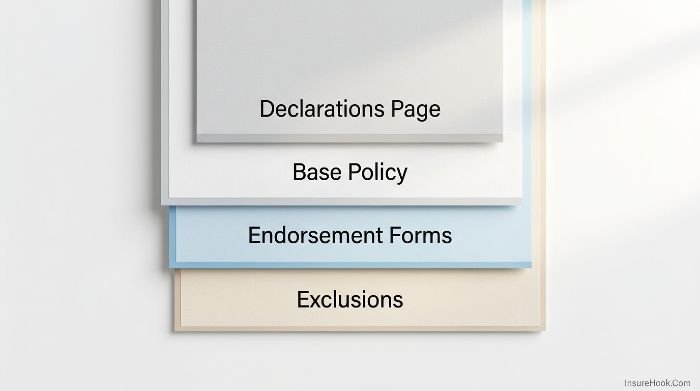
Your declarations page summarizes your active coverage. It also lists current endorsements by form number. The actual endorsement language appears later in your policy packet as separate attached forms.
| Document Layer | What It Contains |
|---|---|
| Declarations Page | Coverage summary and list of endorsement form numbers |
| Base Policy Form | Standard coverage terms and general exclusions |
| Endorsement Forms | Specific modifications that override or expand the base form |
| Exclusion Forms | Items and scenarios the policy explicitly will not cover |
If you see a form number on your declarations page but cannot locate the actual text, contact your insurer and request the complete policy packet. Policyholders are generally entitled to a full copy of their policy documents under standard insurance contract principles. Requirements may vary by state.
The insurance declaration page guide explains how to read each section and what to look for.
When Should You Ask About an Endorsement?
Life changes tend to create coverage gaps. Several situations are worth a conversation with your insurer or agent:
- You started working from home using expensive equipment for client work
- You inherited jewelry, art, or collectibles of meaningful value
- You converted part of your home to a short-term rental
- You added a pool, trampoline, or other feature that may affect liability
- A household member’s situation changed in a way that affects your risk profile
What changed in your household over the past year? That question is worth asking before your next renewal rather than after a claim.
Endorsements and the Underwriting Review
Endorsements are not purely administrative changes. They typically go through a streamlined review by the insurer’s underwriting team. The underwriter evaluates whether the added exposure falls within the carrier’s guidelines for that coverage type.
Most personal lines endorsement requests move through without issue. Declinations are more common in commercial lines or when the added exposure falls outside the carrier’s standard appetite. The insurance underwriting process explains how insurers assess risk at both the policy and endorsement level.
Approval is not guaranteed. That is worth knowing before assuming a requested endorsement went through.
What Happens Without the Right Endorsement
Anonymized example: A homeowner ran a small service business and occasionally met clients at his property. A client tripped during a visit and filed a liability claim. The homeowners insurer denied the claim because the injury was connected to a business activity. The base policy carried a standard business exclusion. No business pursuits endorsement was in place. The denial was consistent with the policy terms as written.
This type of outcome is not unusual. Standard policy exclusions are broad by design. Endorsements exist to address those gaps before a loss occurs.
A denied claim does not always mean the insurer acted unfairly. It often means the specific coverage was never purchased.

How State Laws Affect Endorsement Availability
Insurance regulation in the United States operates at the state level. According to the National Association of Insurance Commissioners, each state maintains its own insurance regulatory framework. Endorsement availability, approved form language, and pricing guidelines differ from state to state.
A form approved in one state may not be available in another. A coverage term that applies in one market may work differently elsewhere.
When comparing policies across carriers, ask specifically which endorsements are approved in your state and what each form number covers. Your state’s department of insurance is the most accurate source on this.
Endorsements and Policy Lapses
An endorsement is a living part of an active policy. If your policy lapses, your endorsements lapse with it.
Reinstatement after a lapse may not automatically restore all prior endorsements. Carriers handle reinstatement differently. Some restore coverage as previously structured. Others conduct a new underwriting review before restoring specific endorsements. Confirm with your insurer before assuming your endorsement coverage came back intact.
Understanding what a policy lapse means for your full coverage picture adds important context here.
Annual Endorsement Review: What to Check Before Renewal
Your renewal period is the practical time to review your endorsement stack. Use this as a starting framework:
Before Your Renewal Date
- Pull your current declarations page and list every endorsement form number
- Match each form number to the actual endorsement text in your policy packet
- Note any life changes from the past year that may have created new coverage needs
During Your Renewal Conversation
- Ask your agent whether any current endorsements still match your situation
- Ask about coverage gaps you identified
- Request written confirmation of any endorsement changes
After Renewal
- Confirm all requested endorsements appear on your new declarations page
- Store a complete copy of your policy packet including all endorsement forms
- Set a calendar reminder for your next annual review

Frequently Asked Questions
The two terms are often used interchangeably. “Rider” is more common in life and health insurance. “Endorsement” is standard in property and casualty lines. Both modify original policy terms in similar ways.
In many cases yes. Contact your insurer to request removal. Some changes take effect immediately. Others apply at your next renewal. Your policy terms or agent can clarify the specific timeline for your situation.
Not necessarily. Endorsements that add coverage typically add cost. Endorsements that remove coverage or make administrative updates may carry no premium change or may slightly reduce your cost. The exact impact depends on your carrier and the specific endorsement.
Your declarations page lists all active endorsements by form number. Request your full policy packet to read the actual language of each one. If any form numbers are unclear, ask your insurer for a plain-language explanation.
In limited circumstances, yes. Insurers may issue endorsements to correct clerical errors or comply with state regulatory changes. These are sometimes called mandatory endorsements or endorsements of condition. Insurers are generally required to notify policyholders in writing when this occurs, though requirements vary by state.
Endorsements are common across most personal and commercial lines including homeowners, renters, auto, and commercial property. Availability depends on your carrier and your state’s approved forms. Not every endorsement type exists in every market.
Disclaimer
This article is for general educational purposes only. It does not constitute legal, financial, or insurance advice. Coverage terms, endorsement availability, pricing, and regulatory requirements vary by state and by insurer.
Consult a licensed insurance professional in your state and review your specific policy documents before making any coverage decisions.
For state-specific regulatory guidance, visit your state’s department of insurance or the NAIC consumer resources page.
⚠️ Always verify information with licensed professionals before making decisions
Article reviewed and updated: May 2026
