


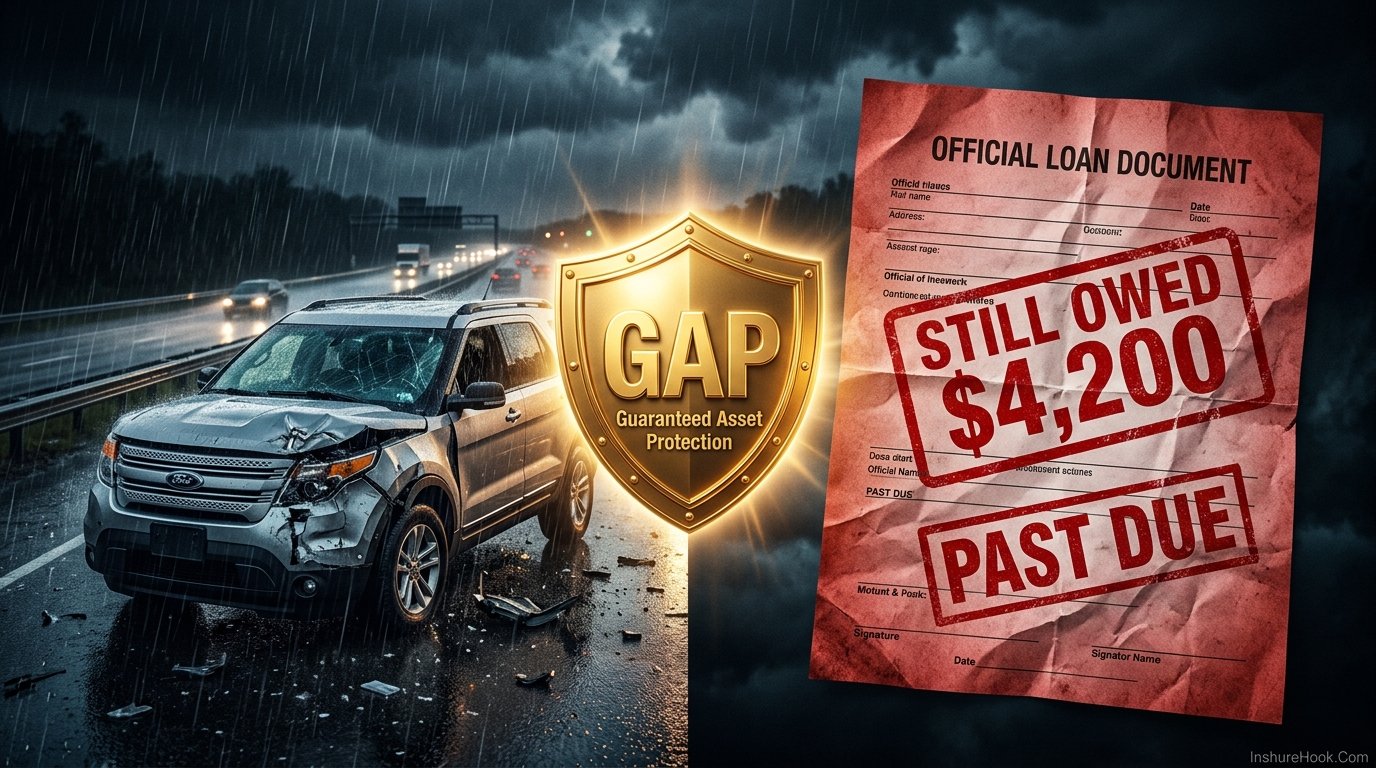
Most people buying a car focus on the monthly payment. The insurance conversation that follows — at the dealership or with their agent — often includes a mention of GAP insurance, sometimes presented as essential, sometimes glossed over. Few buyers walk away with a clear understanding of what it actually does, when it matters, and when it is not worth purchasing.
This guide explains GAP insurance plainly: how it works, the specific situations where it provides real protection, how much it costs through different channels, and how to decide whether your situation actually warrants it.
The Problem GAP Insurance Solves
When a financed vehicle is totaled or stolen and not recovered, your auto insurer pays the vehicle’s actual cash value (ACV) at the time of loss — not the original purchase price, not the remaining loan balance, and not the cost to replace it with a new equivalent model.
Actual cash value accounts for depreciation. Vehicles depreciate significantly in the first few years of ownership. A new car loses roughly 15 to 25 percent of its value in the first year alone and continues depreciating from there. A vehicle purchased for $38,000 may have an ACV of $28,000 two years later.
If you owe $33,000 on the loan and the insurer pays $28,000 based on ACV, you still owe the lender $5,000. You no longer have the vehicle — it has been totaled or stolen — but the loan obligation does not disappear with it. That $5,000 gap between what insurance paid and what you owe is exactly what GAP insurance covers.
Without GAP coverage in this scenario, you pay the $5,000 out of pocket while simultaneously needing to finance a replacement vehicle. With GAP coverage, the insurer pays the difference and your loan is satisfied.

How GAP Insurance Actually Works
GAP stands for Guaranteed Asset Protection. It is not a standalone insurance policy — it is a coverage add-on that works in conjunction with your comprehensive or collision coverage.
Here is the sequence when a total loss or theft occurs with GAP coverage in place:
- Your primary auto insurer settles the total loss claim and pays the ACV minus your deductible
- That payment goes toward your outstanding loan balance
- If the ACV payment does not fully satisfy the loan, GAP coverage pays the remaining balance — the gap between the ACV settlement and what you still owe
- Your loan is paid off in full
What GAP insurance does not cover:
- Deductibles — your collision or comprehensive deductible is still your responsibility. Some GAP policies include a deductible waiver as an add-on, but this is not standard
- Negative equity rolled in from a previous loan — if you owed $5,000 on your trade-in and rolled that into your new loan, that amount is not covered by standard GAP policies
- Missed payments or late fees added to the loan balance
- Extended warranty costs added to the loan
- Overdue fees or penalties on the loan
- The cost of a replacement vehicle
GAP insurance pays the loan payoff gap. It does not compensate you for the vehicle’s value beyond the loan balance, and it does not provide transportation after the loss.
When GAP Insurance Is Worth Having
The financial protection GAP provides is most meaningful when the gap between your loan balance and your vehicle’s ACV is large. Several factors create that situation.
Small or no down payment. When you finance a vehicle with less than 20 percent down, you start with immediate negative equity. The vehicle depreciates faster than the loan balance decreases in the early months. A 5 percent down payment on a $40,000 vehicle means you owe $38,000 immediately after purchase on a vehicle already worth less due to the moment-of-purchase depreciation that occurs as soon as it leaves the lot.
Long loan term. Auto loan terms of 72 or 84 months have become common in the U.S. market. The longer the term, the slower the loan balance decreases each month — and the longer you remain in negative equity territory as depreciation continues. According to data from Experian’s State of the Automotive Finance Market report, the average new vehicle loan term has extended significantly over the past decade. Longer loan terms extend the period during which GAP coverage is relevant.
High-depreciation vehicles. Some vehicle categories depreciate faster than others — luxury vehicles, certain import brands, and models with historically poor resale value. For these vehicles, the gap between ACV and loan balance can be substantial even several years into ownership.
Leased vehicles. Most lease agreements require GAP coverage, and it is typically included in the lease. If you are leasing and the GAP coverage is not explicitly listed in your lease terms, clarify with the leasing company.
Rolling negative equity from a previous trade-in. If you owed more on your previous vehicle than it was worth and rolled that balance into your new loan, you started your new loan deeper in negative equity than the vehicle’s actual depreciation would create on its own.

When GAP Insurance Is Not Necessary
GAP insurance costs money and is not always justified. It becomes unnecessary or irrelevant in several situations.
Significant down payment. If you put 20 percent or more down on a vehicle purchase, the immediate depreciation hit is largely absorbed by the down payment. You may start the loan with positive equity or very close to it — meaning no meaningful gap exists to cover.
Short loan term with rapid paydown. On a 36 or 48-month loan at standard payment amounts, the loan balance decreases quickly. After the first 12 to 18 months, many borrowers reach a point where the ACV exceeds the remaining balance — positive equity. At that point, GAP coverage is no longer needed.
Purchasing a low-depreciation vehicle. Vehicles with strong resale value — certain Toyota, Honda, and Subaru models consistently appear on lists of low-depreciation vehicles — maintain ACV more closely aligned with loan balances. The gap risk is smaller throughout the loan period.
Paying cash or near-cash. If there is no loan, there is no gap to cover. GAP insurance only applies to financed or leased vehicles.
Late in the loan. If you are more than two to three years into a standard-term loan and have been making regular payments, your loan balance has likely decreased enough that the ACV exceeds it. Check your payoff amount against the vehicle’s current ACV — tools like Kelley Blue Book at kbb.com provide current market value estimates.
Where to Buy GAP Insurance and What It Costs
This is one of the most practically important aspects of GAP insurance that dealers rarely explain clearly.
Dealership GAP insurance is the most commonly offered and the most expensive option. Dealers typically charge $400 to $900 as a lump sum, often rolled into the loan — meaning you pay interest on the GAP premium for the life of the loan. The markup on dealer-sold GAP products is significant.
Auto insurer GAP coverage is available from most major insurers as an add-on to your auto policy. It is typically priced at $20 to $40 per year — often $5 to $10 per month added to your premium. This is far less expensive than dealer GAP products for the same protection and can be canceled when your loan balance drops below the vehicle’s ACV.
Bank or credit union GAP coverage is offered by many lenders at the time of vehicle financing. Pricing varies but is generally more competitive than dealer products — typically $200 to $400 as a one-time fee. Some credit unions include GAP coverage at no extra charge as a membership benefit.

The cost difference is substantial. A dealer charging $700 rolled into a 72-month loan at 7 percent interest actually costs the borrower closer to $1,000 over the loan term. The same protection through your auto insurer at $25 per month for 24 months — the period when it is most relevant — costs $600 total, with the flexibility to cancel once positive equity is achieved.
Recommendation: If you need GAP coverage, purchase it through your auto insurer or a credit union rather than through the dealership.
GAP Insurance and New Car Replacement Coverage
Some insurers offer new car replacement coverage as an alternative or companion to GAP insurance. Rather than paying the difference between ACV and loan balance, new car replacement coverage pays for a brand-new vehicle of the same make, model, and trim level in the event of a total loss.
New car replacement coverage is typically available only for vehicles that are less than one or two years old and have fewer than 15,000 miles. It is more expensive than GAP insurance but provides a broader benefit — you receive a new replacement vehicle rather than just loan payoff.
For buyers who want both loan protection and a guaranteed replacement, some insurers bundle GAP and new car replacement together. This is worth comparing against purchasing GAP coverage alone, particularly in the first 12 to 18 months of a new vehicle purchase.
Canceling GAP Insurance When You No Longer Need It
If you purchased GAP coverage through your auto insurer as a policy add-on, you can cancel it at any time when your loan balance drops below your vehicle’s current ACV.
To determine when to cancel:
- Check your current loan payoff amount through your lender’s online account or by calling
- Check your vehicle’s current ACV through Kelley Blue Book (kbb.com) or the National Automobile Dealers Association guides (nadaguides.com)
- If the ACV exceeds the payoff amount, GAP coverage is providing no meaningful protection — cancel it and redirect the premium
If you purchased GAP through the dealership as a lump sum rolled into the loan, cancellation may be more complex. Review the dealer’s GAP contract for cancellation terms — many allow prorated refunds in the early months but become non-refundable after a certain point.
Understanding your full auto coverage structure — which coverages are active, what each costs, and when any given coverage is no longer necessary — is part of the broader picture covered in this auto insurance policy guide.
GAP Insurance and Leased Vehicles
Leased vehicles present a slightly different GAP situation. In a lease, you do not own the vehicle — the leasing company does. If the vehicle is totaled, the insurance settlement goes to the leasing company. If the settlement is less than the remaining lease obligation, you are responsible for the difference unless GAP coverage is in place.
Most lease agreements include GAP coverage as part of the lease terms — it is typically built into the monthly lease payment. Before signing a lease, confirm in the contract whether GAP is included. If it is not, adding it through your auto insurer is the same process as for a purchased vehicle.
A Practical Example
Jordan buys a new crossover for $42,000 with 5 percent down ($2,100) and finances $39,900 over 72 months at 6.5 percent interest. Eighteen months later, the vehicle is totaled in an accident.
At 18 months, the vehicle’s ACV based on current market conditions is $30,500. The remaining loan balance is $34,200.
Without GAP insurance:
- Insurer pays: $30,500 (ACV) minus $500 deductible = $30,000
- Remaining loan balance after settlement: $34,200 − $30,000 = $4,200 owed by Jordan
- Jordan still owes $4,200 on a vehicle he no longer has, while needing to finance a replacement
With GAP insurance:
- Insurer pays: $30,000 (ACV minus deductible)
- GAP pays: $4,200 (remaining loan balance after ACV payment)
- Loan is paid in full
- Jordan is responsible only for his $500 deductible
The GAP coverage cost in this example — purchased through Jordan’s insurer at $25 per month for 18 months — was $450. It prevented a $4,200 out-of-pocket obligation.

Frequently Asked Questions
No U.S. state requires GAP insurance by law. Lenders may require it as a condition of financing for specific loan structures, and lease agreements often include it as a standard term. For standard vehicle purchases, GAP is optional.
Standard GAP insurance does not cover your collision or comprehensive deductible — the deductible reduces the ACV payment from your primary insurer, and the GAP calculation begins from that reduced figure. Some insurers offer a deductible waiver rider that adds deductible coverage to a GAP policy. Check your specific policy terms.
Yes, through your auto insurer, typically within a defined window — often within 12 months of the vehicle purchase date. Dealer GAP products are generally available only at the time of purchase. If you financed your vehicle without GAP and are still in negative equity, adding it through your insurer is the practical path.
If you purchased GAP through your auto insurer, it is tied to your policy — not your original lender — and continues through a refinance. If you purchased it through the dealership or original lender, refinancing may terminate that coverage. Confirm the terms before refinancing if you have dealer-purchased GAP.
If purchased through your auto insurer, cancel it as soon as the loan is paid off. If purchased through the dealership, review the cancellation terms in your contract. Some dealer products offer a prorated refund if canceled early; others do not.
Your deductible applies first — it reduces the ACV payment from your primary insurer. GAP then covers the difference between the reduced ACV payment and your outstanding loan balance. If your deductible is $1,000, GAP insurance absorbs the gap created by both depreciation and the deductible amount above the ACV payment. Understanding collision and comprehensive coverage helps clarify how these coverages sequence.
Disclaimer: This article is intended for general educational purposes only and does not constitute legal, financial, or insurance advice. GAP insurance terms, pricing, and availability vary by insurer, lender, and state. Vehicle depreciation rates and loan balance figures used in examples are illustrative and based on general market conditions as of June 2026. Always review your specific loan and insurance documents and consult a licensed insurance professional for guidance tailored to your situation.
Written by Imran Ahmad, content writer specializing in insurance education | InsureHook.com
Content reviewed against publicly available industry sources. Readers should verify current GAP insurance options and pricing directly with their insurer or lender.
Sources: Insurance Information Institute (iii.org), National Association of Insurance Commissioners (naic.org), Kelley Blue Book (kbb.com), Experian Automotive (experian.com/automotive)
