


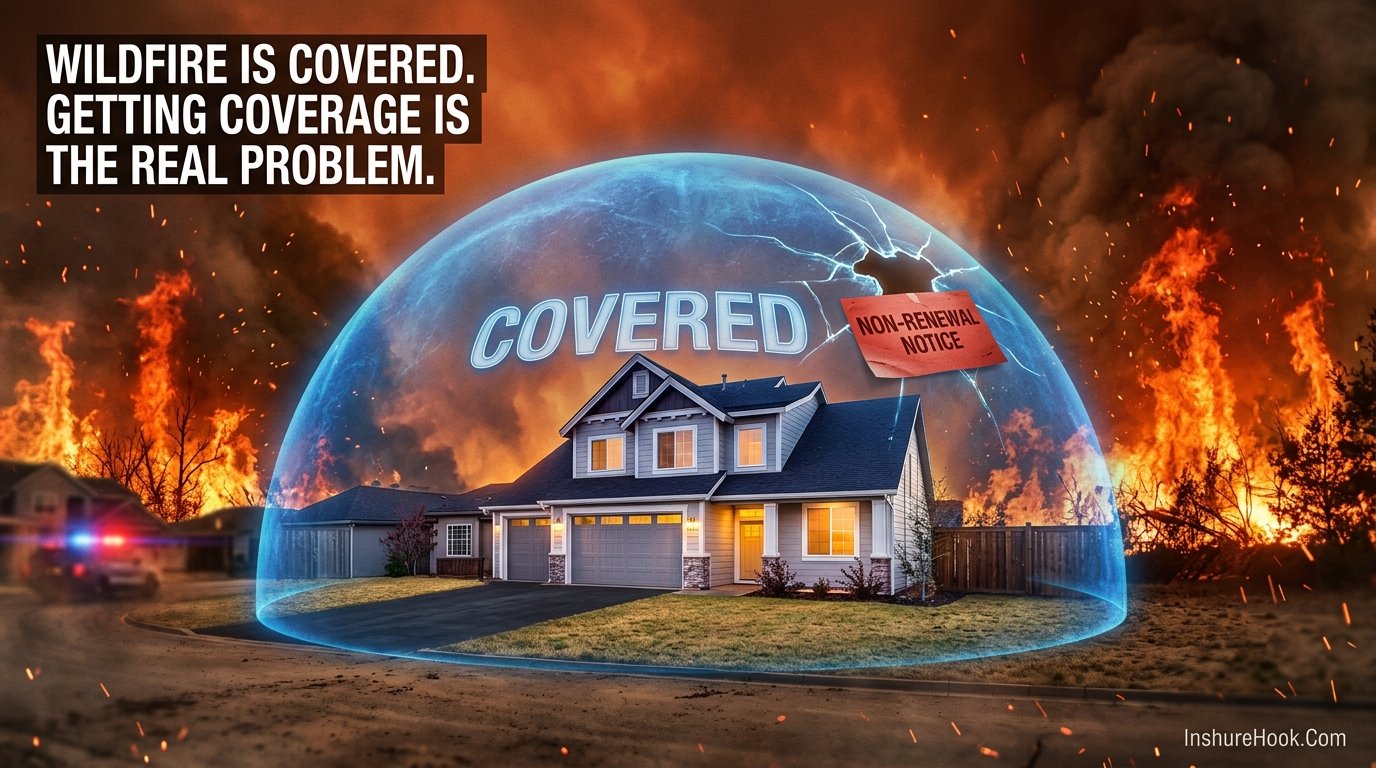
If you live anywhere near wildfire-prone terrain, you’ve probably noticed your home insurance situation getting more complicated over the past few years. Wildfire insurance coverage has become one of the most challenging areas of the property insurance market, with some homeowners facing non-renewal notices, premium increases, or difficulty finding coverage at all. Let’s go through what’s actually covered, why the market has shifted, and what your real options are.
Is Wildfire Damage Covered Under Standard Home Insurance?
Yes — this is actually one area where standard homeowners insurance does provide coverage. Fire, including wildfire, is one of the named perils covered under a standard HO-3 policy. This is different from flooding or earthquakes, which require entirely separate policies.
If your home is damaged or destroyed by wildfire, your dwelling coverage, personal property coverage, and loss of use coverage all apply, just as they would for any other fire-related loss. The challenge isn’t whether wildfire is covered — it’s whether you can obtain or afford coverage in the first place if you live in a high-risk area.
Why the Wildfire Insurance Market Has Changed So Much
Over the past several years, wildfire seasons in California, Colorado, Oregon, Washington, and other western states have grown more severe and more frequent. Climate patterns, prolonged drought conditions, and expanding development into wildland-urban interface areas have all contributed to larger and more destructive fires.
Insurers responded the way insurers generally respond to increased risk: by raising premiums, restricting new policy sales in high-risk zones, and in some cases declining to renew existing policies. Several major insurers significantly reduced their presence in California’s wildfire-prone markets in recent years, citing an inability to price policies profitably given the frequency and severity of recent losses.
This has created real access problems for homeowners in affected areas, regardless of how well they’ve maintained their properties.
What Determines Your Wildfire Risk Rating
Insurers use increasingly sophisticated risk modeling to assess wildfire exposure at the individual property level, not just by general region. Factors that affect your specific risk rating include:
- Distance to wildland vegetation and forested areas
- Local fire history and frequency in your specific area
- Topography — homes on slopes or in canyons often face higher risk due to fire behavior
- Defensible space around your home — cleared vegetation buffer zones
- Construction materials — fire-resistant roofing and siding versus more flammable materials
- Proximity to fire department response capabilities
- Local building codes and whether your home meets current wildfire-resistant construction standards
Some insurers now use satellite imagery and AI-based modeling to assess these factors at a granular level, which is part of why two homes in the same general area can receive very different risk ratings and pricing.

What to Do If You’ve Been Dropped or Denied Coverage
If your insurer has non-renewed your policy or declined to offer coverage due to wildfire risk, you have several options, though none are without trade-offs.
State FAIR Plans
Most wildfire-prone states maintain a FAIR Plan (Fair Access to Insurance Requirements) — a state-backed insurance pool designed as a last resort for homeowners who can’t find coverage in the standard market. The California FAIR Plan is the largest and most well-known example, specifically created to address wildfire-related coverage gaps.
FAIR Plan coverage is typically more limited and more expensive than standard market policies. It often covers only the dwelling itself, requiring you to purchase a separate policy (called a “DIC” or difference-in-conditions policy) for personal property, liability, and other coverages that a standard policy would bundle together.
Surplus Lines Insurance
Surplus lines carriers are insurers that operate outside the standard, regulated insurance market and can offer more flexible underwriting for high-risk properties. These policies are typically more expensive and come with less regulatory oversight than standard admitted insurers, but they can be an option when standard carriers won’t write a policy at all.
Specialty Wildfire Insurers
A growing number of insurers specialize specifically in wildfire-prone properties, using more sophisticated risk assessment than older actuarial models. These insurers may offer coverage where traditional carriers won’t, though often at a premium reflecting the specialized risk assessment involved.

Steps That Can Improve Your Insurability
Beyond finding alternative coverage, there are concrete steps that can improve your standing with insurers and potentially reduce your premium or restore eligibility for standard market coverage.
Create and maintain defensible space. Most wildfire-prone states have specific defensible space requirements — typically clearing vegetation within 100 feet of structures. Insurers increasingly verify this through satellite imagery, and compliance can be the difference between renewal and non-renewal.
Upgrade to fire-resistant materials. Class A fire-rated roofing, ember-resistant vents, and non-combustible siding all reduce a structure’s vulnerability and can favorably affect underwriting.
Join a Firewise USA community. The National Fire Protection Association’s Firewise USA program recognizes communities that implement coordinated wildfire mitigation efforts. Some insurers offer discounts or improved underwriting consideration for homes within recognized Firewise communities.
Document your mitigation efforts. Photos and records of defensible space maintenance, roof upgrades, and other fire-resistant improvements can support your case when applying for coverage or appealing a non-renewal decision.
Consider a wildfire risk assessment. Some insurers and independent companies offer professional wildfire risk assessments that identify specific vulnerabilities and provide a report you can use both for your own mitigation planning and to demonstrate proactive risk management to insurers.
Understanding Your Coverage Limits in a Total Loss Scenario
Wildfire losses are frequently total losses — meaning the structure is completely destroyed rather than partially damaged. This makes understanding your dwelling coverage limit and replacement cost provisions particularly important if you’re in a high-risk area.
Construction costs have risen substantially in recent years, and a coverage limit set several years ago may no longer reflect actual current rebuild costs in your area. After major wildfire events, rebuild costs in affected regions often spike further due to increased demand for contractors and materials simultaneously across a large number of affected properties.
Reviewing your dwelling coverage limit against current local rebuild costs — not your original purchase price or even last year’s coverage amount — is worth doing annually if you’re in a wildfire-prone area. The what does homeowners insurance cover guide explains how dwelling coverage limits should be calculated in more detail.
Extended Replacement Cost Coverage
Given how dramatically rebuild costs can spike after a major wildfire event due to regional construction demand surges, some insurers offer extended replacement cost coverage — which pays beyond your stated dwelling limit, often up to 125% or 150% of that amount, if rebuild costs exceed your coverage due to circumstances like post-disaster construction inflation.
This type of endorsement is particularly valuable in wildfire-prone regions specifically because of how localized construction cost spikes tend to follow major fire events. It typically costs a modest additional premium relative to the protection it provides.
Loss of Use During Extended Rebuilding Periods
After a major wildfire destroys a home, rebuilding can take a year or more, particularly when an entire community is rebuilding simultaneously and contractors are in high demand. Your loss of use coverage — which pays for temporary housing while your home is being rebuilt — typically has a time limit, often 12 to 24 months, though some policies offer extensions.
If you’re in a high-risk area, checking your specific loss of use time limit and considering whether to extend it is worth discussing with your insurer, given how much longer rebuilding can take following a widespread disaster compared to an isolated single-property loss.

Pros and Cons of Living in a Wildfire-Prone Area From an Insurance Perspective
Pros:
- Standard fire coverage, including wildfire, remains part of basic homeowners policies
- Specialty insurers and FAIR Plans provide coverage options even when standard carriers decline
- Mitigation efforts can meaningfully improve insurability and pricing over time
- Extended replacement cost endorsements address post-disaster cost spikes
Cons:
- Premiums in high-risk areas have risen substantially and may continue rising
- Standard market non-renewals are increasingly common in the highest-risk zones
- FAIR Plan and surplus lines coverage is typically more expensive and more limited
- Total loss rebuilding can take significantly longer following widespread regional disasters
FAQs
It’s possible, particularly if your specific property scores poorly on an insurer’s risk model due to vegetation proximity, topography, or lack of defensible space. Not every home in a general wildfire region faces the same individual risk rating, and mitigation efforts can meaningfully affect your specific score.
Yes, renters insurance covers wildfire damage to your personal belongings the same way it covers other named perils like standard fires. The building itself is the landlord’s responsibility, but your personal property coverage and loss of use benefits apply if you’re displaced due to wildfire damage to your rental unit.
Yes, in most wildfire-prone states, the FAIR Plan exists specifically as a coverage option for homeowners who can’t find standard market coverage. It’s more limited and typically more expensive, but it ensures you can obtain at least basic dwelling coverage required by your mortgage lender.
Both, in many cases. Insurers increasingly use defensible space compliance as both an underwriting factor (affecting whether you’re approved) and a pricing factor (affecting your premium), since well-maintained defensible space statistically reduces the likelihood of structure loss during a wildfire event.
This is happening in some of the highest-risk zones. If standard carriers won’t write policies in your area at all, the FAIR Plan or surplus lines carriers become your primary options. Some homeowners in extreme cases have also explored relocating, though this is obviously a significant decision that goes well beyond insurance considerations alone.
