



At a Glance: An insurance claim is a formal request you submit to your insurer asking them to pay for a covered loss or service under your policy. The insurer reviews the claim, verifies coverage, and issues payment if the loss qualifies. The process varies by insurance type — a health insurance claim works very differently from a homeowners or auto claim — but the core principle is the same across all of them.
You buy insurance hoping you never need to use it. Then something happens — a car accident, a burst pipe, a hospital stay, a theft — and suddenly the policy you paid premiums on for months or years needs to actually do something. That moment is when a claim begins.
Most people have a vague sense of what filing a claim involves. Far fewer understand the full process: what triggers it, what happens after you file, what the insurer is actually evaluating, and what your obligations are throughout. This guide covers all of it.
What an Insurance Claim Is
An insurance claim is a formal notification to your insurer that a covered event has occurred and you are requesting payment under your policy. It is not a complaint or a request for a favor — it is the exercise of a contractual right that exists specifically because you have been paying premiums.
The insurer’s obligation to pay is conditional. Coverage is not automatic. The claim process exists to verify that:
- The event that occurred is covered under your specific policy
- The loss happened during the active policy period
- You met your obligations under the policy (timely notice, cooperation with investigation, mitigation of further damage)
- The claimed amount is accurate and supported by documentation
When all of these conditions are met, the insurer pays the covered amount minus your applicable deductible. When one of them is not met — the event is excluded, the policy had lapsed, notice was not given promptly, or documentation is insufficient — the claim may be reduced or denied.
The Two Broad Categories of Claims
First-Party Claims
A first-party claim is when you file against your own insurance policy for your own loss.
- You file a health insurance claim for your own medical treatment
- You file a homeowners claim for damage to your own home
- You file a comprehensive auto claim for your own vehicle damaged by hail
- You file a life insurance claim as a beneficiary for a death benefit
In first-party claims, your insurer owes its obligation directly to you as the policyholder (or beneficiary).
Third-Party Claims
A third-party claim is when someone else files against your insurance policy because you caused them a loss.
- Another driver files against your auto liability coverage after an accident you caused
- A guest injured at your home files against your homeowners liability coverage
- A client files against your business liability policy for damages you caused
In third-party claims, the claimant is not your insurer’s customer — but your policy obligates your insurer to respond on your behalf up to your coverage limits.
Understanding which type of claim you are dealing with affects the process, your obligations, and how payment flows.

How the Claims Process Works: Step by Step
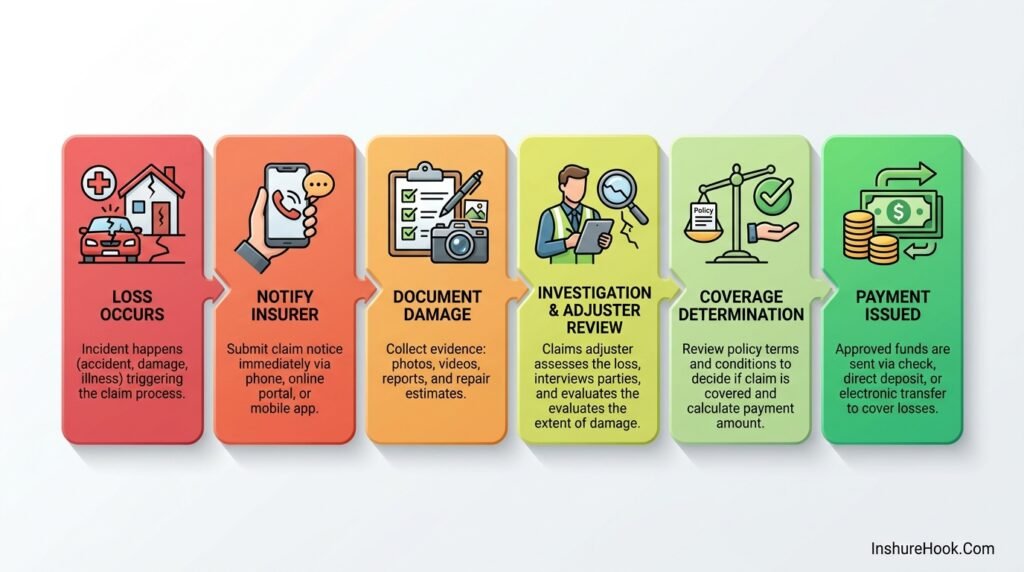
Step 1 — The Covered Event Occurs
A claim begins with a loss or event. This might be sudden and obvious — a car accident, a fire, a flood. Or it might be discovered over time — mold found during a renovation, a diagnosis that requires treatment, a theft discovered when you return home.
Not every loss automatically qualifies for a claim. The loss must:
- Fall within a covered peril or benefit under your policy
- Have occurred during the active policy period
- Exceed your deductible (for property and auto claims)
Before filing, a quick review of your insurance declaration page confirms your coverage types, limits, and deductible — the three things that determine whether filing makes practical sense.
Step 2 — Notify Your Insurer Promptly
Most policies require “prompt notice” of a covered loss. Some specify a timeframe — 30 to 60 days is common for property claims. For health insurance, the provider typically handles claim submission on your behalf, but you are still responsible for ensuring your insurer has accurate information.
What to provide when you first report:
- Your policy number
- Date, time, and description of the event
- Location of the loss (for property claims)
- Approximate extent of damage or treatment received
- Any police or incident report numbers (for theft, accidents, or vandalism)
The insurer assigns a claim number. This reference tracks every communication, document, and payment associated with your claim from this point forward. Write it down and reference it in every subsequent contact.
Delayed reporting is one of the most common reasons claims are complicated. Insurers may argue they were prejudiced by the delay — meaning the late notice prevented them from investigating properly. For most claims, reporting as soon as reasonably possible protects your position.
Step 3 — Document Everything
Documentation is the foundation of every claim. Without it, disputes about what happened, when it happened, and what it cost become much harder to resolve in your favor.
For property claims (homeowners, auto):
- Photograph and video all damage before any cleanup or repairs
- Make a written list of damaged items with estimated values
- Keep receipts for any emergency expenses (boarding up windows, temporary accommodation, towing)
- Do not make permanent repairs before the adjuster inspects — preliminary mitigation is expected and appropriate, but final repairs should wait
For health insurance claims:
- Keep all Explanations of Benefits (EOBs) your insurer sends
- Request itemized bills from providers showing each service and billing code
- Document referrals, authorizations, and any communications with your insurer about coverage
For life insurance claims:
- Obtain a certified copy of the death certificate
- Complete the insurer’s claim form accurately
- Gather the original policy if available, though most insurers can locate your policy by Social Security number
Step 4 — Investigation and Adjustment
For property and auto claims, your insurer assigns an adjuster — an individual whose job is to investigate the claim, assess the damage, and determine what the policy owes.

There are three types of adjusters:
| Adjuster Type | Who They Work For |
|---|---|
| Staff adjuster | Your insurance company (salaried employee) |
| Independent adjuster | Contracted by the insurer — still represents insurer interests |
| Public adjuster | You (the policyholder) — you hire and pay them separately |
Staff and independent adjusters both work on behalf of the insurer. They are not adversaries, but their job is to assess the claim accurately within the policy’s terms — not to maximize your payout.
A public adjuster works exclusively for you. For large or complex claims — significant fire damage, major water loss, extensive structural damage — some policyholders hire a public adjuster to advocate on their behalf. They typically charge 10 to 20 percent of the settlement. For smaller, straightforward claims, the cost usually is not justified.
The adjuster inspects the damage, reviews documentation, researches local labor and material costs, and produces an estimate. For auto claims, industry software called Xactimate is commonly used for structural estimates. For auto damage, the insurer’s estimate is compared against shop quotes.
For health insurance claims, the “adjustment” is largely automated — the insurer’s system applies your plan’s contracted rates, deductible status, and cost-sharing rules to produce the Explanation of Benefits.
Step 5 — Coverage Determination
After the investigation, the insurer makes a formal coverage determination. This is where policy language matters most.
The insurer is deciding:
- Is this event covered under the policy?
- What exclusions, if any, apply?
- What sublimits apply to this type of loss?
- What is the actual covered loss amount?
- What does the policy owe after applying the deductible?
Actual Cash Value vs. Replacement Cost Value is a critical distinction here for property claims. ACV policies pay the depreciated value of what was lost — what a used item of that age and condition is worth today. RCV policies pay what it costs to replace the item with a new equivalent. The difference can be substantial on older items.
For auto claims, the insurer calculates your vehicle’s actual cash value if it is declared a total loss. Understanding collision vs. comprehensive coverage helps clarify how each type of auto loss is evaluated.
Step 6 — Payment
Once coverage is confirmed, the insurer issues payment. How and to whom depends on the claim type.
Property claims: Payment may be issued in stages. An initial check reflects ACV. A supplemental payment is issued after repairs are completed and documented for RCV policies. If you have a mortgage, your lender is likely listed as a loss payee and checks may be made jointly to you and the lender — requiring coordination with your mortgage servicer to release funds.
Health claims: Payment goes directly to the in-network provider in most cases. For out-of-network care or when you paid out of pocket, reimbursement is sent to you. The Explanation of Benefits documents every detail of what was billed, allowed, paid, and owed.
Life insurance claims: The death benefit is paid directly to named beneficiaries after the claim is verified. Most insurers complete straightforward life claims within 30 to 60 days of receiving complete documentation. For a detailed explanation of how this payout process works, this life insurance beneficiary payout guide covers what beneficiaries need to know.
Auto liability claims (third party): Your insurer pays the claimant directly up to your liability limits.
When a Claim Gets Denied
Claim denials happen. Not every denial means the insurer acted unfairly — many denials reflect legitimate policy exclusions or documentation gaps. But some denials are incorrect, and you have the right to challenge them.
Common reasons for denial:
- The event falls under a policy exclusion (flood damage under a standard homeowners policy, pre-existing condition exclusion on a non-ACA plan, mechanical breakdown on an auto policy)
- The policy had lapsed at the time of the loss due to nonpayment — understanding what a policy lapse means and how to avoid it protects you from this outcome
- Late notice — the claim was reported outside the policy’s required timeframe
- Insufficient documentation — the loss amount cannot be verified
- Material misrepresentation on the original application
Your options when a claim is denied:
- Request the denial in writing with specific reference to the policy language supporting it
- Review that language against your actual policy documents
- File a formal appeal with the insurer — include any additional documentation that supports your position
- Invoke the appraisal clause for disputed property amounts (both parties appoint independent appraisers; an umpire resolves disagreements)
- File a complaint with your state’s department of insurance if you believe the denial was improper
- Consult an insurance attorney — many take policyholder cases on contingency
The National Association of Insurance Commissioners provides a consumer complaint portal and state regulator directory for further guidance.
How Claims Affect Your Future Premiums
Filing a claim has consequences beyond the immediate payout. Understanding these before you file helps you make a more informed decision — particularly for smaller losses.
CLUE report: Property and auto claims are recorded in your Comprehensive Loss Underwriting Exchange (CLUE) report. This database is checked by insurers when you apply for new coverage or renew an existing policy. Claims remain on the report for five to seven years.
Premium impact: At-fault auto claims typically produce the largest premium increases — often 20 to 45 percent at renewal, depending on severity and insurer. Homeowners claims, particularly water and liability claims, can also trigger rate increases or non-renewal. Weather-related comprehensive auto claims (hail, for example) generally have a smaller premium impact because they reflect an environmental event rather than a behavioral risk indicator.
The small claim calculation: For losses near your deductible — say, $900 damage with a $750 deductible — the net claim payment is $150. Filing produces $150 today but may generate a premium increase that costs far more over the next three to five years. For genuinely small losses, paying out of pocket and keeping a clean claims history is often the better financial decision.
Inquiries vs. claims: Some insurers record even informal inquiries on the CLUE report. If you call to ask whether a loss is covered without formally filing, that inquiry may appear. When in doubt about whether to file, ask your agent how the inquiry will be recorded before providing details.

Claims by Insurance Type: Key Differences
Health Insurance Claims
Health insurance claims are usually filed on your behalf by the provider. When you see an in-network provider, they submit the claim directly to your insurer. You receive an Explanation of Benefits afterward showing what was billed, what was allowed, what the insurer paid, and what you owe.
For out-of-network care, you may need to file the claim yourself by submitting the provider’s itemized bill and your insurer’s claim form.
The most important health claim concept to understand is the in-network vs. out-of-network distinction. Out-of-network care can result in significantly higher cost-sharing and balance billing. The in-network vs. out-of-network guide explains exactly how this affects what you owe.
Homeowners Insurance Claims
Homeowners claims involve the most complex investigation process of any personal insurance type. The home insurance claims process guide walks through every step in detail — from the first call to final payment.
Key considerations specific to homeowners claims:
- Duty to mitigate — you must take reasonable steps to prevent further damage
- Do not make permanent repairs before adjuster inspection
- Document everything before any cleanup
- Understand whether your policy pays ACV or RCV for personal property and the dwelling
Auto Insurance Claims
Auto claims divide into two main categories: first-party physical damage claims (collision and comprehensive) and third-party liability claims.
For first-party claims, you file through your own policy and pay your deductible. For third-party claims where another driver is at fault, you file against their liability policy — and pay no deductible for that process.
Understanding how car insurance deductibles work clarifies your out-of-pocket exposure in each scenario.
Life Insurance Claims
Life insurance claims are filed by beneficiaries after the insured person’s death. The process requires a death certificate, a completed claim form, and in some cases the original policy. Most straightforward claims are paid within 30 to 60 days. Claims filed during the two-year contestability period may involve additional review of the original application for accuracy.

Practical Checklist: Before You File a Claim
Before formally submitting any claim, work through these questions:
- Is this event covered under my policy’s named perils or insuring agreement?
- Did the event occur during my active policy period?
- Does the loss amount meaningfully exceed my deductible?
- Have I documented the damage or loss thoroughly?
- Have I taken reasonable steps to prevent further damage?
- Do I understand how this claim may affect my future premium?
- For property claims — have I avoided making permanent repairs before adjuster inspection?
- For health claims — have I confirmed the provider is in-network?
- Do I have my policy number and claim contact information ready?
Frequently Asked Questions
State laws set timelines. Most states require acknowledgment of a claim within 10 to 15 business days and a coverage decision within 30 to 45 days of receiving complete documentation. Payment must follow promptly after a decision is made. Check your state’s department of insurance for the specific requirements that apply to your policy.
For theft, vandalism, and auto accidents involving another party, a police report is strongly recommended and often required. For property damage claims from weather or accidents with no other party involved, a police report may not be required — but check your policy’s conditions section.
Subrogation is the process by which your insurer recovers from a responsible third party what they paid on your behalf. If another driver caused an accident and your insurer paid your collision claim, they may pursue the at-fault driver’s insurer for reimbursement. If subrogation succeeds, your deductible is typically returned to you.
No. Life insurance claims have no deductible — the full death benefit is paid. Liability coverage within homeowners and auto policies typically has no deductible for third-party claims. Deductibles apply primarily to first-party physical damage claims in property and auto insurance, and to most health insurance services (with exceptions for copay-based services).
Most property policies include an appraisal clause — a formal dispute resolution process where each party appoints an independent appraiser and an umpire resolves disagreements. This is separate from a full legal dispute and often faster. Your state’s department of insurance also handles complaints if you believe the insurer acted in bad faith.
Insurers cannot cancel your policy mid-term solely because you filed a claim in most states. However, at renewal, a history of multiple claims can lead to non-renewal. State laws regulate how much advance notice an insurer must give for non-renewal. The insurance grace period guide explains the difference between cancellation and non-renewal and what notice requirements apply.
Disclaimer: This article is intended for general educational purposes only and does not constitute legal, financial, or insurance advice. Claim processes, coverage terms, state regulations, and insurer practices vary significantly. Information reflects general industry practices as of June 2026. Always review your specific policy documents and consult a licensed insurance professional in your state for guidance tailored to your situation.
Written by Imran Ahmad, content writer specializing in insurance education | InsureHook.com
Content reviewed against publicly available industry sources. Readers should verify current claim procedures and regulations directly with their insurer or a licensed professional.
Sources: National Association of Insurance Commissioners (naic.org), Insurance Information Institute (iii.org), Healthcare.gov (healthcare.gov)
