



Imagine it’s like you were paying for a gym membership instead of paying your electric bill. One of them will charge you a flat fee per month regardless of anything. The other one can vary in accordance with its use. Fixed vs Variable insurance premiums work on the same basis and understanding which you take out can mean real differences in the predictability of your budget – sometimes for years and years.
On the surface it seems rather easy. Things become more interesting when you realize that not all of the words are used in the way you would think of, particularly in life insurance. Let’s get down to it.
Fixed Premium, What is it?
A fixed premium is set for a certain term without taking into account external factors. The amount you pay remains fixed each month (or year) of your policy, and doesn’t change until your policy is over or renews on different terms.
The simplest one is a term life insurance. A 20 year level term policy will ensure that your premium will remain fixed for 20 years. The premium on a whole life insurance is similar; they’re usually going to be the same premium, regardless of when you make the payment.
So are the premiums for auto and home insurance, but only for each policy period. For 6 or 12 months you pay a fixed premium, and remain in the same rate until it is renewed, when your insurer may have new data to use in a repricing.
So What is a Variable Premium?
The premiums are variable and may fluctuate, either up or down, depending on the specified conditions in the policy or the renewal terms.
The best known of which is health insurance. Your premium may also vary annually depending on your age band, plan level or any changes that are made to all plans by your insurance provider. You don’t just pick a “random” number – it is calculated on a formula.
Universal life insurance goes one step further, allowing you to have control over it. You can pay in during the better years and receive less in lean years within limits of your insurance company, and the policy adjusts the amount of cash value you get accordingly.
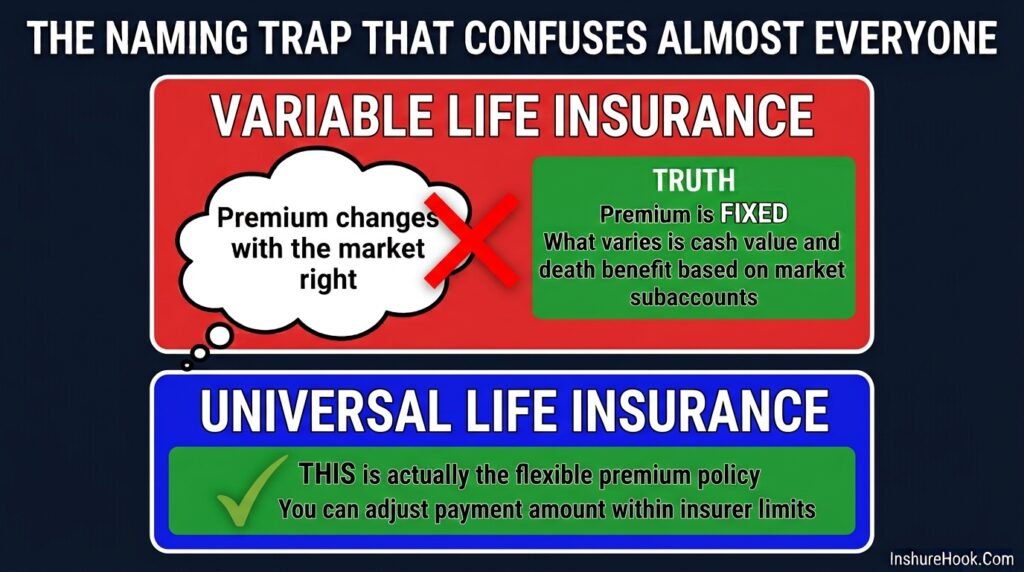
There is a Naming Trap that pretty much everyone gets into.
It is here that it gets truly confusing and a little time should be taken to see it through. Fixed premiums are actually the norm in a life insurance product, which is actually given the name “variable life insurance. The amount of the payment cannot be changed.
It’s not the premium that’s different. It’s the cash value and death benefit, because the money is invested in market-based subaccounts which can increase or decrease during the market cycle. In the meantime, the one that has actually flexible premiums that you can increase or reduce is called “universal life insurance.”
If your policy uses the word variable in its name, however, don’t conclude that it means that you’ll have to pay on a variable basis. Almost never does it, it.
A Quick Comparison Across Life Insurance Types
| Policy Type | Premium Flexibility | What Actually Varies |
|---|---|---|
| Term Life | Fixed for the term | Nothing; premium and benefit stay level |
| Whole Life | Fixed for life | Cash value grows at a guaranteed, steady rate |
| Universal Life | Flexible, adjustable | Premium amount and, within limits, death benefit |
| Variable Life | Fixed | Cash value and death benefit, based on market performance |
| Variable Universal Life | Flexible, adjustable | Premium, death benefit, and cash value, all market-linked |
Universal life or variable life insurance may be more complicated than the basic term or whole life policy, so if you’re still undecided on which one to choose, take a look at our term vs whole life insurance guide before you go any further.
This will be the subject of the next lesson.
With a fixed premium you have certainty. You can easily budget since you know exactly what to expect monthly, and won’t be caught off guard with extra fees in the middle of the month.
There is a cost or compromise in being flexible. If such a thing were possible, the only real alternatives are to reduce the amount of the policy or cancel it entirely, as the payment is unlikely to be adjusted to accommodate you half way.

Premia variabili: Valori e Equilibri.
A variable premium takes into account your situation: this can help when you have a variable income and can be useful, especially if it has seasonal or annual variations. You should pay more when you have a lot of money and less when you don’t.
That flexibility is at the cost of less predictability. For example, a universal life policy that is consistently underfunded, can eventually lapse, sometimes without an obvious warning sign, until it does.
How to Make Decision on which Fits You
Self-evaluate: How important is predictability (versus flexibility) to you, in your real life, not your ideal life? With a fixed premium, there’s no pressure to make a choice, and a “set it and forget it” approach is all the more possible.
A variable structure will allow you to move around, if you have a fluctuating income or you particularly want to make cash value and coverage changes as your lifestyle changes, but only if you are diligent enough to watch it rather than let it run on autopilot.
It’s also worth understanding what actually drives your premium number in the first place, whether fixed or variable. Our breakdown of how a life insurance premium is determined covers the underlying factors insurers weigh before you ever see a quote.
In this section, I briefly examine how cash values fit into this.
When considering a policy that offers cash value, such as universal life, whole life or variable life, it’s important to truly grasp what cash value does and how it changes over time. I have already discussed this in our life insurance cash value guide as it directly relates to the amount of options you can really get with a variable premium structure.
If it’s not a concept for life insurance, what is it?
This gap is reflected in other areas as well – just in another form of words in the case of life insurance. Your auto insurance premiums are recomputed when you renew your policies and are based on your claims history, driving records, and even on market forces throughout your region. In our article on calculating car insurance premiums, we take a deep dive into the “variable” concept, and how it applies to a different kind of insurance – car insurance.
A Closer Look at How Health Insurance Premiums Vary
In particular, health insurance is worthy of discussion as a specific area where federal law specifies the factors insurers can and can’t use for the calculation of a premium. The ACA rules that marketplace insurers are allowed to adjust the rates of their plans for only five factors: age, location, tobacco use, plan tier, and dependents coverage.
It’s only fair to say age is a factor in this. The older the enrollee, the higher the legality cap for premiums for the same plan, up to three times greater than for younger enrollees. In most states, the cost of tobacco use is also 50% higher, with a few states, such as California, New York and New Jersey, having no tobacco surcharges at all. Your health, medical history and gender, for example, do not legally play into how much you pay—and not all that long ago, this wasn’t the case.
That’s a real unique type of ‘variable’ policy as it is not the same as a universal life policy where you would be adjusting your payment. It’s being recalculated by your insurance company, according to a predetermined federal formula, and it is largely beyond your control beyond quitting using tobacco or playing the scene at open enrollment. For a more comprehensive explanation of how it works, see our health insurance premiums guide.

Some of the more common problems that people make include the following:
The most common mistake in selecting life insurance is taking a wrong definition of “variable life insurance,” which would be one that allows flexibility.
The other common error is selecting a variable premium just to save the money upfront, without having any goals for its use if you earn more or less. It’s the flexibility that comes with being attentive to the policy year over year that makes it helpful.
But some people believe that, when signing up for premiums such as for auto or home insurance, that they have locked in their actual premium forever, when they’re actually locked in for the term of the policy. The number could be a different one when renewal.
Frequently Asked Questions
Not during a locked-in period, insurers are able to adjust it at the time of renewal for an auto, home, or a health policy. In contrast, term and/or whole life insurance premiums are actually stable for the duration of the policy or term.
Not necessarily. It is more on flexibility than on the cost. Depending on the way you finance the variable structure, and the way your insurer’s formula is constructed, the variable structure can begin at a lower level and gradually increase over time or it can begin at a higher level and decrease over time.
The name comes from the fact that the value of your policy, your cash value and your death benefit will change depending on how well the markets perform, not on how much you pay. It’s a naming strategy which confuses many customers.
A variable or universal structure will have more flexibility to move around, but will need to be more managed. On the other hand, if you don’t want to have to keep an eye on a policy, then a fixed premium would be non-existent, even if it’s stingier on a tight month.
If you don’t fund it regularly it can, Don’t assume that universal and variable universal life policies are self-sustaining – check in with the policy at least annually to see that the cash value is not falling below the cost of maintaining it.
The Bottom Line
A fixed premium provides you with the certainty. An advantage of a variable premium is flexibility, but you’re also responsible for the flexibility in the long run. There’s no definitive right or wrong answer, and the decision as to which one to pick is usually based more on how stable your income is and how you’re willing to put in time after you’ve signed up for a policy. Take the time to read the fine print to find out how and when your particular premium may be changing and don’t assume that either label indicates “as is”.
