


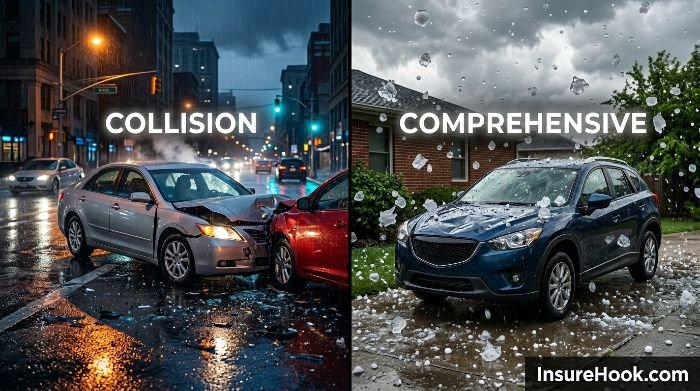
Quick Answer: Collision coverage pays for damage to your car when it strikes another vehicle or object. Comprehensive coverage pays for damage caused by events outside your control — theft, weather, fire, or animal contact. Both carry separate deductibles. Lenders typically require both on financed or leased vehicles.
The One Question That Separates These Two Coverages
The clearest way to tell collision from comprehensive apart is to ask a single question: What caused the damage?
If your car was damaged because it physically struck something — another vehicle, a guardrail, a parking barrier, a utility pole — that is a collision claim.
If your car was damaged by something that happened to it rather than something you drove it into — a hailstorm, a theft, a fire, a fallen tree branch, a deer that ran into the road — that is a comprehensive claim.
The name “comprehensive” misleads some drivers into thinking it covers everything. It does not. It covers everything except collision. The two coverages exist side by side because they address two entirely different categories of risk.
What Collision Coverage Pays For
Collision coverage responds when your vehicle physically strikes or is struck by another object. Fault plays a limited role in whether the coverage applies — your own collision coverage responds regardless of who caused the accident, as long as a physical impact occurred.
Common collision scenarios:
- Your car hits another vehicle at an intersection, whether you were at fault or not
- You slide on ice and strike a curb, barrier, or guardrail
- Another driver rear-ends your parked car and you file through your own policy for faster resolution
- Your car rolls over in a single-vehicle accident
- You back into a parking structure pillar or fence post
- You clip a parked car while pulling out of a space
One scenario worth understanding: if another driver causes the accident and their liability insurance accepts responsibility, you can file against their policy and avoid using your own collision coverage entirely. But if liability is disputed, or if the at-fault driver is uninsured, filing through your own collision coverage allows repairs to proceed without waiting for a liability determination.
Your insurer may then pursue the at-fault party through a process called subrogation — attempting to recover what they paid on your behalf. If successful, your deductible may be returned to you.

What Comprehensive Coverage Pays For
Comprehensive auto insurance covers losses that happen to your vehicle — events that do not involve your car colliding with another object.
Common comprehensive scenarios:
- Your car is stolen from a parking lot, driveway, or street
- A hailstorm dents the hood, roof, and trunk panels
- Rising floodwater enters the interior during a storm
- A tree branch or utility pole falls onto the vehicle
- A deer or other animal runs into your path and strikes the car
- A rock or road debris cracks or shatters your windshield
- Fire from an external source destroys the vehicle
- Vandalism — keyed paint, broken windows, graffiti
One detail that catches drivers off guard: animal contact is almost universally treated as a comprehensive claim, not collision. Your car did not crash into the deer. The animal entered the roadway and the contact happened. The cause — an event outside your control — places it in the comprehensive category regardless of how the impact occurred.
Another common point of confusion: if you swerve to avoid an animal and strike a guardrail, that impact is a collision claim. The guardrail contact is what caused the damage, not the animal.
Side-by-Side Comparison
| Scenario | Collision | Comprehensive |
|---|---|---|
| Crash with another vehicle | ✅ Covered | ❌ Not covered |
| Single-car accident | ✅ Covered | ❌ Not covered |
| Rollover accident | ✅ Covered | ❌ Not covered |
| Vehicle theft | ❌ Not covered | ✅ Covered |
| Hail or weather damage | ❌ Not covered | ✅ Covered |
| Flood damage | ❌ Not covered | ✅ Covered |
| Animal strike | ❌ Not covered | ✅ Covered |
| Falling objects | ❌ Not covered | ✅ Covered |
| Fire damage | ❌ Not covered | ✅ Covered |
| Windshield cracked by debris | ❌ Not covered | ✅ Covered |
| Vandalism | ❌ Not covered | ✅ Covered |
| Typical deductible range | $250 – $1,500 | $0 – $1,000 |
| Generally more expensive | Yes | No |
| Required by lenders | Usually yes | Usually yes |
How Deductibles Work for Each Coverage
Both collision and comprehensive carry their own separate deductibles. These can be set independently — a $1,000 collision deductible with a $250 comprehensive deductible is a completely normal combination.
Collision deductibles tend to run higher because collision claims are more frequent and typically involve greater repair costs. Common ranges fall between $500 and $1,500, though some policies extend to $2,000 for drivers choosing lower premiums.
Comprehensive deductibles are usually lower. Some insurers offer $0 deductible options specifically for glass or windshield claims. Several states — including Florida, Kentucky, and South Carolina — require insurers to offer zero-deductible windshield repair or replacement under comprehensive coverage.
How the deductible math works in a real claim:
A hailstorm causes $3,400 in damage to your vehicle. Your comprehensive deductible is $500. Your insurer pays $2,900. If the repair estimate had come in at $400 and your deductible was $500, filing a claim would produce no payment — you would cover the full repair cost yourself, and filing would still appear on your claims record.
Understanding how your deductible choice affects your real costs — both monthly premiums and out-of-pocket exposure after a loss — is covered in detail in this car insurance deductible guide.

What Lenders Require and Why
If your vehicle is financed through a bank, credit union, or leasing company, the lender almost certainly requires you to carry both collision and comprehensive coverage. Their reasoning is straightforward: they have a financial interest in the vehicle until the loan is paid off, and they want that asset protected against both crash damage and non-collision losses.
The requirement disappears the moment you pay off the loan. At that point, coverage decisions become entirely yours. This is also where some drivers make a costly mistake — they drop one or both coverages because the requirement is gone, without fully considering whether the financial risk is actually manageable.
A practical scenario:
A driver pays off a three-year-old crossover and quietly drops collision coverage to reduce monthly costs. Several months later, another driver runs a stop sign and hits the car on the passenger side. The at-fault driver’s property damage liability limit is lower than the repair estimate. Without collision coverage to bridge the gap, the driver is left negotiating directly with the other insurer and accepting a lower settlement.
Fault determination matters in this situation. So does having your own coverage as a fallback. Dropping collision on a vehicle that still holds significant market value leaves a specific and real gap.
Should You Carry Both, One, or Neither?
There is no universal answer. The right decision depends on your vehicle’s current market value, your financial position, your location, and whether a lender requires coverage.
A widely referenced benchmark: if your annual premium for a specific coverage exceeds 10 percent of your vehicle’s current market value, the math may not support carrying it. For a car worth $4,000 with a $1,000 deductible, the maximum net payout from a total loss claim is $3,000. If collision costs $600 per year, you are paying 20 percent of your maximum possible recovery annually.
That is a starting point for the decision, not the whole decision. Other factors:
Geography matters. Drivers in hail-prone states — Texas, Colorado, Oklahoma, Kansas — see real comprehensive claims regularly. Drivers in high-theft urban areas face meaningful risk without comprehensive. Flood exposure in coastal areas adds another layer of consideration.
Vehicle age and value matter. For newer or financed vehicles, carrying both almost always makes sense. For a vehicle worth $4,000 to $6,000, the cost-benefit analysis is worth running carefully.
Your financial buffer matters. If a total loss would create genuine hardship — difficulty replacing the vehicle or absorbing repair costs — the coverage cost is likely justified even if the math is not perfect.
“The core question is whether you can absorb a total vehicle loss without serious financial disruption. If the answer is no, dropping collision or comprehensive to save $30 or $40 per month is almost always a mistake.” — Licensed property and casualty insurance professional, 15+ years advising personal auto policyholders

What “Full Coverage” Actually Means
“Full coverage” is informal language — it is not a defined insurance term. What most drivers mean when they use it is a policy that combines liability, collision, and comprehensive together.
Here is how the three main coverage types divide responsibility:
- Liability coverage pays for damage and injuries you cause to other people and their property
- Collision coverage pays for damage to your own car from a physical impact
- Comprehensive coverage pays for damage to your own car from non-collision events
No single coverage handles everything. Each one addresses a different category of risk. Dropping any one of them creates a specific gap in your protection that the other two do not fill.
What Comprehensive Does Not Cover
Because the word “comprehensive” implies total protection, drivers regularly assume this coverage reaches further than it does. It does not cover:
Mechanical failures. If your transmission fails, your engine seizes, or any mechanical component wears out, neither collision nor comprehensive applies. That is a mechanical issue, not an insured event. Extended warranties or separate mechanical breakdown insurance policies address this.
Personal belongings inside the vehicle. A laptop, camera, or bag stolen from your car is not a comprehensive claim. Those items are personal property covered under your renters insurance or homeowners insurance policy.
Damage you cause to another person’s vehicle or property. That falls under liability coverage.
Your own medical bills after an accident. Medical payments coverage or personal injury protection addresses this, depending on your state.
Normal wear and tire blowouts. Routine degradation is maintenance, not an insured loss.
How Claims Work for Each Coverage
Collision claims involve a fault determination. Your insurer investigates who caused the accident, coordinates with other insurers when another vehicle is involved, and issues payment for covered repairs minus your deductible. If another driver is at fault, your insurer may pursue subrogation to recover what they paid. If successful, your deductible may be returned.
Comprehensive claims generally do not involve fault. A weather event, theft, or animal strike happened. You file the claim, an adjuster assesses the damage, and payment is issued minus your deductible. There is no fault question because the event was not caused by a driver’s actions.
Premium impact after claims: At-fault collision claims tend to have a larger effect on renewal premiums than comprehensive claims. Weather-related comprehensive claims — hail damage, for example — are often treated as lower-risk indicators because the event was environmental and outside the driver’s control. Individual insurers handle this differently, and state regulations add another variable.
GAP Insurance and How It Connects
When a financed vehicle is declared a total loss, the insurer pays the vehicle’s actual cash value at the time of the loss — which reflects depreciation, not the original purchase price or remaining loan balance. For newer vehicles that depreciate quickly, this can leave a gap between the payout and what is still owed to the lender.
GAP insurance covers that difference. It is a separate product from collision and comprehensive but works alongside them. If you are financing a vehicle purchased within the last one to three years, understanding how these coverages interact is worth reviewing before a loss occurs.

Current Factors Affecting Comprehensive and Collision Costs in 2026
The auto insurance market went through significant stress between 2022 and 2024. Supply chain disruptions made parts expensive and difficult to source. Repair labor costs rose sharply. Total loss valuations increased as used vehicle prices climbed. By 2026, the market has partially stabilized but premiums remain elevated compared to pre-2022 levels.
For drivers evaluating whether to carry both coverages, the increased cost of repairs actually strengthens the case for keeping them — especially collision, where repair costs on newer vehicles have risen significantly. A minor parking lot collision that might have cost $1,800 to repair several years ago can now easily run $3,000 or more on a vehicle with modern sensors and cameras built into bumpers.
A broader breakdown of how these and other factors affect your overall premium is available in this guide to how car insurance premiums are calculated.
Coverage Checklist Before Adjusting Your Policy
Work through this before dropping, adding, or changing either coverage:
- Find your vehicle’s current actual cash value using Kelley Blue Book (kbb.com) or NADA Guides (nadaguides.com)
- Calculate your annual premium for collision separately from comprehensive
- Check whether a lender or lease company requires either coverage
- Review your deductibles to confirm they reflect your current financial situation
- Check your state’s average hail, flood, or theft risk if reconsidering comprehensive
- Confirm whether your policy includes rental reimbursement or whether it needs to be added
- Review how a prior claim on either coverage affected your premium at the last renewal
Frequently Asked Questions
No state currently requires comprehensive coverage on vehicles you own outright. Minimum coverage requirements across all 50 states address liability coverage only. Comprehensive becomes a practical requirement when a lender or leasing company is involved.
Collision is generally the more expensive of the two. It covers higher-frequency events and tends to involve larger repair costs. Comprehensive addresses less frequent events on average, which keeps its cost lower.
If the driver cannot be identified, you file through your own collision coverage. You pay your deductible and your insurer covers the covered repair cost. Uninsured motorist property damage coverage, where available in your state, may also apply.
Generally yes. Windshield damage from road debris or a weather event is a comprehensive claim. Florida, Kentucky, and South Carolina require insurers to offer zero-deductible windshield repair or replacement under state law.
Yes. Some drivers with paid-off older vehicles choose this combination — keeping protection against theft and weather while skipping the more expensive collision coverage because the vehicle’s market value does not justify it. This is a legitimate coverage choice as long as no lender requires collision.
It can. At-fault collision claims typically carry the largest premium impact. Comprehensive claims — especially weather-related ones — often have a smaller effect because they reflect an environmental event rather than a driving behavior. State regulations and individual insurer guidelines affect exactly how each claim type is rated at renewal. The National Association of Insurance Commissioners publishes consumer guidance organized by state for further reference.
Subrogation is the process by which your insurer recovers from a third party what they paid on your behalf. If you filed a collision claim because another driver caused the accident, your insurer pays your repair costs and then pursues the at-fault driver’s insurer for reimbursement. If subrogation succeeds, your deductible is typically returned to you. It does not always succeed, and the timeline varies.
Disclaimer: This article is intended for general educational purposes only and does not constitute legal, financial, or insurance advice. Coverage terms, deductible options, state requirements, and pricing vary by insurer and location. Laws governing auto insurance change over time. Consult a licensed insurance professional in your state for guidance tailored to your specific situation. Information reflects general industry practices as of June 2026.
Written by Imran Ahmad | InsureHook.com Sources: National Association of Insurance Commissioners (naic.org), Insurance Information Institute (iii.org), Kelley Blue Book (kbb.com), NADA Guides (nadaguides.com)
