



Quick Answer: An insurance grace period is a set number of days after your premium due date during which your policy remains active even if payment has not been received. Length varies by insurance type and state law — typically 10 to 31 days. If payment is not made before the grace period ends, the policy lapses and coverage stops.
What an Insurance Grace Period Is
When a premium payment is due and not received on time, most insurance policies do not immediately terminate. Instead, they enter a grace period — a defined window during which the policy continues to provide coverage while the insurer waits for payment.
The grace period exists to protect policyholders from sudden coverage gaps caused by minor payment delays. A payment that gets lost in the mail, a banking error, a brief cash flow issue — these are ordinary occurrences that insurers account for by building this buffer into policy terms.
The grace period is not a penalty-free extension of your due date. It is a temporary continuation of coverage during which payment is still expected. A claim filed during the grace period is generally covered — but if payment is never received before the grace period expires, the policy lapses retroactively or from the end of the grace period, depending on the insurer and policy terms.
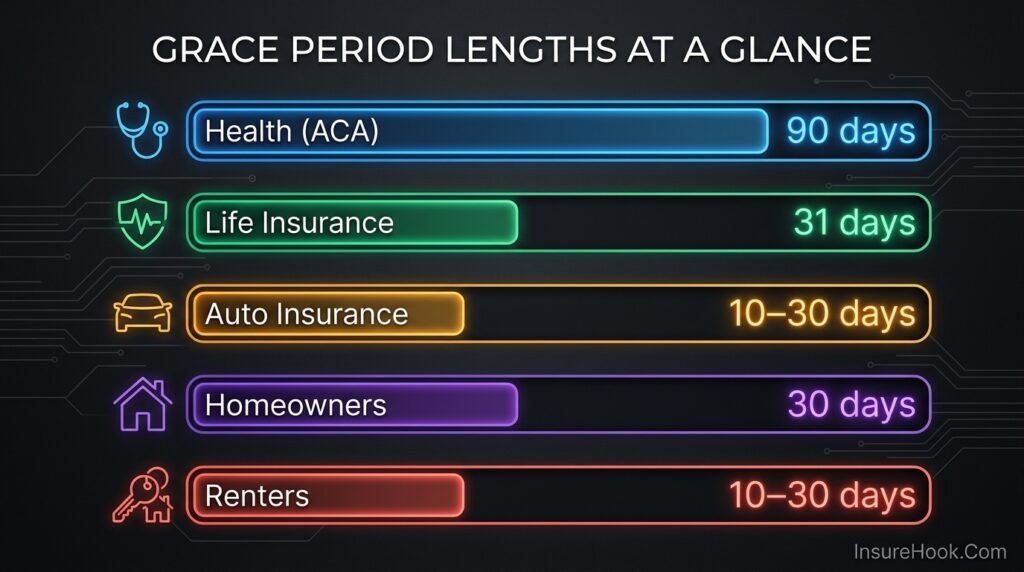
Grace Period Length by Insurance Type
Grace periods are not uniform. They vary significantly based on the type of insurance, the insurer’s own terms, and state law — which in many cases establishes a minimum grace period that all policies must offer.
Health Insurance
Health insurance grace periods depend on how the policy was obtained.
ACA marketplace plans paid with premium tax credits: Federal law under the Affordable Care Act provides a 90-day grace period for enrollees who receive advance premium tax credits (APTC). However, the structure is specific. The insurer is only required to hold claims for payment during the second and third months of the grace period. During the first month, claims must be paid as normal. If payment is not received by the end of the 90-day period, the policy is terminated back to the end of the first month — meaning claims submitted during months two and three may be denied retroactively.
Employer-sponsored health plans: These typically follow the employer’s payroll and billing structure. Grace periods are often shorter — commonly 30 days — and are governed by the plan’s summary plan description rather than ACA marketplace rules.
Individual health plans without tax credits: These follow the insurer’s standard terms and applicable state law, typically 30 days.
Medicare Advantage and Part D plans: CMS guidelines generally require a grace period of at least 30 days for premium nonpayment. Specific terms depend on the plan.
Life Insurance
Life insurance policies are required by state law to include a minimum grace period, typically 30 to 31 days from the premium due date. This requirement applies across term and permanent life insurance and is one of the most consistently regulated areas of insurance grace periods.
If a policyholder dies during the grace period before paying the overdue premium, the death benefit is still payable — but the unpaid premium is deducted from the death benefit paid to beneficiaries.
For permanent life insurance policies that have accumulated cash value, a lapsed policy may trigger an automatic premium loan — the insurer automatically borrows against the policy’s cash value to cover the missed premium, keeping the policy active. This feature is specific to policies with cash value and does not apply to term life.
Auto Insurance
Auto insurance grace periods are less standardized than health or life insurance because they are governed primarily by insurer contract terms rather than uniform state mandates. Many insurers offer a grace period of 10 to 30 days, but this is not guaranteed by law in most states.
A critical point: during an auto insurance grace period, if a claim is filed, the insurer may process it normally. But some insurers reserve the right to deny coverage or cancel without a formal grace period for nonpayment — check your policy declarations and state law carefully.
New vehicle additions: Many auto policies include a grace period specifically for adding a newly purchased vehicle to an existing policy — commonly 14 to 30 days. This is a different type of grace period than nonpayment; it addresses the window during which a new car is automatically covered under the existing policy before being formally added.
Homeowners Insurance
Homeowners insurance grace periods for nonpayment are typically 30 days, though insurer terms vary. Insurers are generally required to provide written notice of cancellation before a policy is terminated for nonpayment — most states require at least 10 days’ notice for nonpayment cancellations on homeowners policies.
If your homeowners insurance is paid through an escrow account managed by your mortgage lender, the lender is responsible for making premium payments on time. A lapse in coverage under this arrangement can trigger force-placed insurance — coverage arranged by the lender to protect their interest in the property. Force-placed insurance is typically more expensive than standard homeowners coverage and protects the lender’s interest, not the homeowner’s belongings. Understanding how homeowners insurance works with a mortgage escrow is important for any financed homeowner.
Renters Insurance
Renters insurance grace periods are generally 10 to 30 days and governed by individual policy terms. Because renters insurance premiums are relatively low, nonpayment lapses are typically resolved quickly — but a lapse during a burglary or fire leaves personal property unprotected.
Grace Period vs. Reinstatement: Two Different Situations
These two terms address different scenarios and are often confused.

A grace period applies when a payment is late but the policy has not yet been formally cancelled. The policy is still technically in force. Coverage continues. Filing a claim during a grace period is generally valid.
Reinstatement applies after a policy has lapsed — meaning the grace period expired without payment and the policy was cancelled. At this point, coverage has ended. To resume coverage, the policyholder must apply for reinstatement, which may involve:
- Paying all overdue premiums plus any applicable fees
- Completing a reinstatement application
- Answering health questions (for life and health insurance)
- Undergoing underwriting review for certain policy types
Reinstatement is not guaranteed. The insurer can decline to reinstate a policy or may offer reinstatement only with new terms. For life insurance, any health changes that occurred during the lapse period may be factored into the reinstatement decision.
The difference matters practically: if you are still within the grace period, you have time to pay and remain continuously covered. If the policy has already lapsed, you are looking at a different and more complicated process. Understanding the full consequences of a policy lapse is covered in detail in this insurance policy lapse guide.
What Happens to Claims Filed During a Grace Period
This is one of the most practically important aspects of grace period rules and one of the least clearly understood.
The general rule: A claim filed while a policy is in grace period status is covered — because the policy has not yet lapsed. The insurer typically processes the claim and deducts the overdue premium from the claim payment.
The exception to watch for: Some insurers, particularly in auto insurance, structure their grace periods differently. Their policies may specify that coverage is suspended during the grace period, not merely pending payment. In those cases, claims during the grace period may be denied. This is why reading your specific policy language — not just assuming the general rule applies — matters.
Health insurance specific rule: Under ACA marketplace plans with APTC, claims during the second and third months of the 90-day grace period are held in a pending status by providers and may be denied retroactively if the enrollee does not pay before the grace period ends. Providers are required to notify patients that their coverage is in grace period status, but the practical result can be significant medical bills returned to the patient if the premium is never paid.
State Regulation of Grace Periods
Insurance is regulated at the state level in the United States, and grace period minimums vary by state and policy type. State law establishes floors — minimums that all policies must meet — but insurers can and sometimes do offer longer grace periods than the law requires.
Life insurance has the most consistent state-level regulation. Most states mandate a minimum 30-day grace period by statute.
Health insurance grace period rules are a combination of state law and federal law (ACA), with the federal rules taking precedence for marketplace plans.
Auto and homeowners insurance grace periods are more often governed by individual policy terms within the broader framework of state cancellation notice requirements. Most states require advance written notice before cancellation for nonpayment — often 10 days for nonpayment, 30 days for other reasons.
The National Association of Insurance Commissioners provides a state insurance regulator directory where consumers can find their state’s department of insurance for specific grace period requirements by coverage type.
How Grace Periods Appear in Your Policy Documents
Your grace period terms are not always prominently displayed. They are most commonly found in:
The declarations page: This summarizes your policy’s key terms. Some insurers list the grace period length here.
The policy conditions section: This is where most payment, cancellation, and reinstatement terms are spelled out in detail. It is worth reading this section when you first receive a policy.
Cancellation and nonrenewal provisions: Grace period terms often appear alongside the insurer’s notice requirements for cancellation.
If you cannot locate the grace period information in your policy documents, your insurer’s customer service line can confirm it. Getting the answer in writing — via email confirmation — creates a record you can reference if a dispute arises later.
Understanding your insurance declarations page makes it easier to navigate the rest of your policy documents.
Automatic Payment and Grace Period Risk
Enrolling in automatic payment removes most grace period risk for straightforward billing situations. But automatic payments create their own set of failure points:
- A card expires and the updated number was not provided to the insurer
- A bank account is changed and the new account was not linked
- A payment is returned due to insufficient funds and the automatic retry fails silently
- The insurer changes billing systems and existing payment authorizations are not migrated correctly
Most insurers notify policyholders of a failed automatic payment — but the notification may go to a rarely checked email address or be filtered as spam. By the time it is noticed, the policy may be deep into the grace period.

Best practice: Set a calendar reminder to verify the payment processed successfully two to three days after each scheduled billing date. Confirm either through your bank statement or the insurer’s online account portal.
What Happens When the Grace Period Ends Without Payment
If the grace period expires without a successful payment, the policy enters lapse status. The consequences vary by insurance type.
Health insurance: Coverage ends. Any medical services used after the lapse date are no longer covered by the insurer. Under ACA marketplace plans with APTC, as described above, the retroactive lapse to the end of the first grace period month means providers may be asked to reverse payment for claims already processed.
Life insurance: The policy lapses. For term life, coverage simply ends — there is no cash value to extend it. For permanent life insurance with cash value, the insurer may apply an automatic premium loan if available, but if cash value is insufficient, the policy lapses. The death benefit is no longer payable. Future reinstatement involves underwriting review.
Auto insurance: Coverage ends. Driving without insurance violates state financial responsibility laws in all U.S. states. Penalties include fines, license suspension, and vehicle registration revocation. A lapse in auto insurance also appears as a gap in your continuous coverage history, which most insurers rate as higher risk at the next renewal — meaning your premium increases when you do reinsure.
Homeowners insurance: Coverage ends. For mortgaged properties, the lender is notified and force-placed insurance may be activated — at a higher cost to the homeowner. For owned-outright properties, the home is simply uninsured.
The broader consequences of a lapsed policy — including effects on future insurability and premium history — are explained in this insurance policy lapse guide.
Practical Steps If You Cannot Make a Premium Payment on Time
If you anticipate missing a premium payment, early action is always better than late action.
1. Contact your insurer before the due date. Some insurers offer hardship extensions, payment deferrals, or the ability to change your billing due date to better align with your income schedule. These options are most available when requested proactively, not after a grace period has already started.
2. Confirm your grace period length. Call or log into your account to confirm exactly how many days your grace period provides. Do not assume.
3. Evaluate whether a lower coverage level is available. For auto insurance, some insurers allow temporary adjustments — such as suspending comprehensive and collision on a vehicle you are not driving — to reduce the premium while keeping the policy active.
4. For health insurance, check subsidy eligibility. If a significant income change has occurred, a special enrollment period may allow you to re-enroll in an ACA marketplace plan with updated subsidy calculations. Healthcare.gov provides current enrollment and subsidy information at healthcare.gov.
5. Prioritize which policies to maintain if resources are limited. Health and auto insurance are typically most time-sensitive. Auto coverage is legally required for vehicles being driven. Health coverage gaps can result in denied claims for care received during the lapse.
Grace Periods and the Continuous Coverage Benefit
Maintaining continuous coverage — no gaps — has a real financial benefit beyond just keeping you protected. Most auto and homeowners insurers offer lower premiums to customers who demonstrate uninterrupted coverage history. A lapse, even a short one, breaks that record and typically results in a higher starting rate when coverage is resumed.
For auto insurance specifically, a coverage gap of 30 days or more is flagged in underwriting. The premium impact varies by insurer and state, but rate increases of 10 to 30 percent are common for drivers who come in with a recent lapse history.

This means the cost of letting a policy lapse — even briefly — often exceeds the premium savings from the missed payment.
Summary: Grace Period Key Facts by Insurance Type
| Insurance Type | Typical Grace Period | Governed By | Claims During Grace Period |
|---|---|---|---|
| ACA Marketplace (with APTC) | 90 days | Federal ACA rules | Month 1: paid. Months 2–3: held, may be denied retroactively |
| Individual Health (no APTC) | 30 days | State law + insurer | Generally covered |
| Life Insurance | 30–31 days | State law (mandated) | Covered; unpaid premium deducted from death benefit |
| Auto Insurance | 10–30 days | Insurer terms | Varies; some suspend coverage during grace period |
| Homeowners Insurance | 30 days | Insurer terms + state notice rules | Generally covered |
| Renters Insurance | 10–30 days | Insurer terms | Generally covered |
Frequently Asked Questions
It depends on the policy and insurance type. For most life and health policies, claims during the grace period are valid. For some auto policies, the grace period language may specify that coverage is suspended — not continued — during nonpayment. Review your specific policy’s conditions section. If the language is unclear, request a written explanation from your insurer.
Insurance premium payments are generally not reported to credit bureaus the way loan payments are, so a single late insurance payment typically does not affect your credit score directly. However, if an unpaid premium is referred to a collections agency after a lapse, that collections account can appear on your credit report.
Not automatically. Acceptance of payment after a lapse does not necessarily mean the insurer has agreed to reinstate coverage for the period it lapsed. You need written confirmation of reinstatement with an effective date. Without that confirmation, you may have paid a premium without actually having coverage restored.
No. Auto insurance grace periods for nonpayment are not uniformly mandated by state law the way life insurance grace periods are. Many states have cancellation notice requirements — meaning the insurer must notify you before cancelling — but this is different from a guaranteed grace period with active coverage. Check your policy language and your state department of insurance for the rules that apply to you.
No. These are two different provisions. A grace period applies to late premium payments on an active policy. A free look period is a window — typically 10 to 30 days — given to a policyholder immediately after purchasing a new policy during which they can review it and cancel for a full refund. They serve different purposes at different points in the policy lifecycle.
The grace period still applies, but the responsibility for the premium payment is shared. For employer-sponsored plans, the employer manages premium payments to the insurer. If the employer fails to remit payment, the employee’s coverage is still at risk. ERISA provides some employee protections in these situations, but they are complex. If you believe your employer has failed to remit premium payments, contacting your state’s department of labor is a practical first step.
Disclaimer: This article is intended for general educational purposes only and does not constitute legal, financial, or insurance advice. Grace period terms, state minimum requirements, and claim handling practices vary by insurer, policy type, and state law. References to ACA provisions reflect rules as of June 2026. Always review your specific policy documents and consult a licensed insurance professional for guidance tailored to your situation.
Written by Imran Ahmad | InsureHook.com Sources: National Association of Insurance Commissioners (naic.org), U.S. Centers for Medicare & Medicaid Services (cms.gov), Healthcare.gov (healthcare.gov), Insurance Information Institute (iii.org)
