


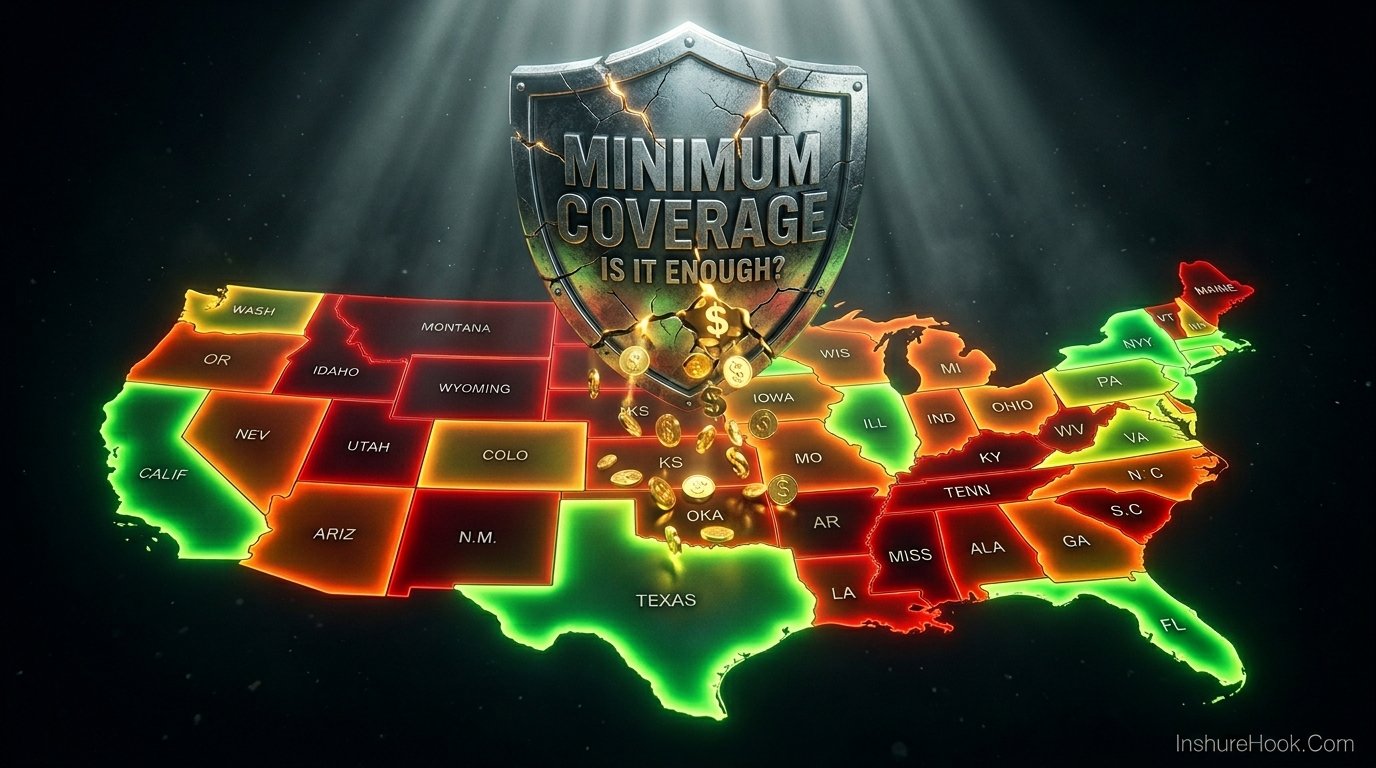
Every state in the U.S. requires drivers to carry some form of auto insurance or demonstrate financial responsibility before legally operating a vehicle. But what that minimum looks like varies significantly from one state to the next — and understanding your state’s specific requirements is not just a legal formality. It directly affects how much protection you actually have after an accident.
This guide covers what minimum auto insurance requirements mean, how they differ across states, why the minimums are often insufficient for real-world accidents, and what coverage decisions actually protect you beyond compliance.
What Minimum Car Insurance Requirements Actually Mean
State minimum requirements set the floor — the least coverage you must carry to legally register and drive your vehicle. They do not represent adequate coverage for most accidents, and they say nothing about your own vehicle’s protection.
Most state minimums focus on liability coverage — insurance that pays for injuries and property damage you cause to other people when you are at fault in an accident. Liability coverage does not pay for your own injuries or your own vehicle’s damage. It protects others from your financial risk on the road.
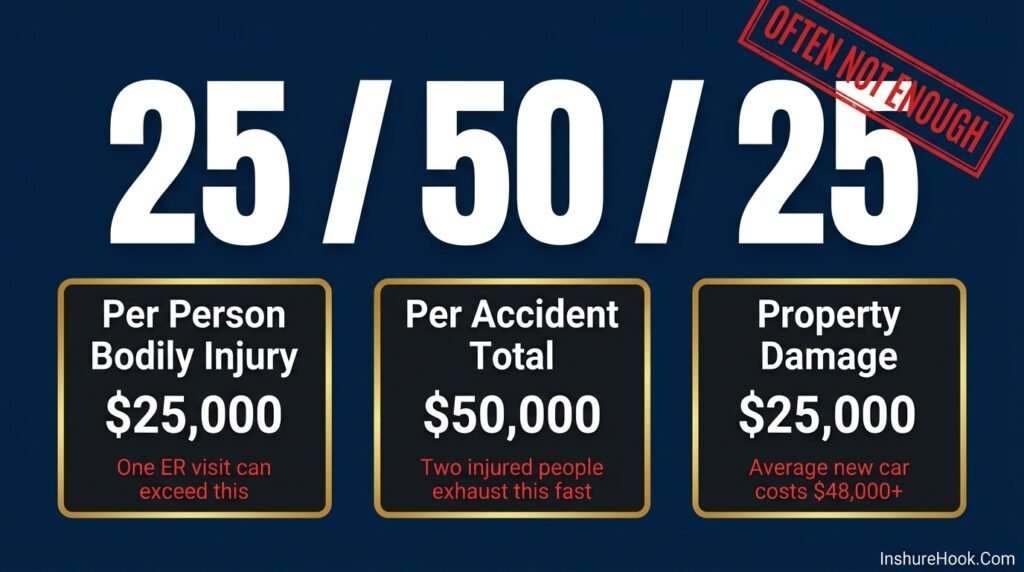
Standard liability coverage is expressed as three numbers, often written in shorthand. A requirement of 25/50/25 means:
- $25,000 per person for bodily injury
- $50,000 per accident for bodily injury (total, across all injured parties)
- $25,000 for property damage to other vehicles or structures
If you cause an accident that injures two people with medical bills of $40,000 each and damages a vehicle worth $30,000, a 25/50/25 policy falls short on every count. You are personally liable for the remainder.
Minimum Requirements by State: 2026
The following table reflects state minimum liability requirements as of 2026. Requirements are verified against state department of insurance sources. Some states have updated minimums in recent years — California raised its minimums effective January 1, 2025, for the first time in decades.
| State | Bodily Injury (per person / per accident) | Property Damage | Additional Required Coverage |
|---|---|---|---|
| Alabama | $25,000 / $50,000 | $25,000 | — |
| Alaska | $50,000 / $100,000 | $25,000 | — |
| Arizona | $25,000 / $50,000 | $15,000 | — |
| Arkansas | $25,000 / $50,000 | $25,000 | — |
| California | $30,000 / $60,000 | $15,000 | — |
| Colorado | $25,000 / $50,000 | $15,000 | — |
| Connecticut | $25,000 / $50,000 | $25,000 | UM/UIM required |
| Delaware | $25,000 / $50,000 | $10,000 | PIP required |
| Florida | No BI requirement | $10,000 PD | $10,000 PIP required |
| Georgia | $25,000 / $50,000 | $25,000 | — |
| Hawaii | $20,000 / $40,000 | $10,000 | PIP required |
| Idaho | $25,000 / $50,000 | $15,000 | — |
| Illinois | $25,000 / $50,000 | $20,000 | UM required |
| Indiana | $25,000 / $50,000 | $25,000 | — |
| Iowa | $20,000 / $40,000 | $15,000 | — |
| Kansas | $25,000 / $50,000 | $25,000 | PIP + UM/UIM required |
| Kentucky | $25,000 / $50,000 | $25,000 | PIP required |
| Louisiana | $15,000 / $30,000 | $25,000 | — |
| Maine | $50,000 / $100,000 | $25,000 | UM/UIM + MedPay required |
| Maryland | $30,000 / $60,000 | $15,000 | PIP + UM/UIM required |
| Massachusetts | $20,000 / $40,000 | $5,000 | PIP + UM required |
| Michigan | $50,000 / $100,000 | $10,000 | PIP required |
| Minnesota | $30,000 / $60,000 | $10,000 | PIP + UM/UIM required |
| Mississippi | $25,000 / $50,000 | $25,000 | — |
| Missouri | $25,000 / $50,000 | $25,000 | UM required |
| Montana | $25,000 / $50,000 | $20,000 | — |
| Nebraska | $25,000 / $50,000 | $25,000 | UM/UIM required |
| Nevada | $25,000 / $50,000 | $20,000 | — |
| New Hampshire | No mandate* | — | Financial responsibility proof |
| New Jersey | $25,000 / $50,000 | $25,000 | PIP required |
| New Mexico | $25,000 / $50,000 | $10,000 | — |
| New York | $25,000 / $50,000 | $10,000 | PIP + UM required |
| North Carolina | $30,000 / $60,000 | $25,000 | UM/UIM required |
| North Dakota | $25,000 / $50,000 | $25,000 | PIP + UM/UIM required |
| Ohio | $25,000 / $50,000 | $25,000 | — |
| Oklahoma | $25,000 / $50,000 | $25,000 | — |
| Oregon | $25,000 / $50,000 | $20,000 | PIP + UM required |
| Pennsylvania | $15,000 / $30,000 | $5,000 | PIP required |
| Rhode Island | $25,000 / $50,000 | $25,000 | — |
| South Carolina | $25,000 / $50,000 | $25,000 | UM required |
| South Dakota | $25,000 / $50,000 | $25,000 | UM/UIM required |
| Tennessee | $25,000 / $50,000 | $15,000 | — |
| Texas | $30,000 / $60,000 | $25,000 | — |
| Utah | $25,000 / $50,000 | $15,000 | PIP required |
| Vermont | $25,000 / $50,000 | $10,000 | UM/UIM required |
| Virginia | $30,000 / $60,000 | $20,000 | UM/UIM required |
| Washington | $25,000 / $50,000 | $10,000 | — |
| West Virginia | $25,000 / $50,000 | $25,000 | UM/UIM required |
| Wisconsin | $25,000 / $50,000 | $10,000 | UM/UIM required |
| Wyoming | $25,000 / $50,000 | $25,000 | — |
| Washington D.C. | $25,000 / $50,000 | $10,000 | UM required |
*New Hampshire does not mandate auto insurance but requires drivers to demonstrate financial responsibility equal to minimum coverage amounts if involved in an accident.
Important: State minimum requirements change periodically through legislation. Always verify your state’s current requirements directly with your state’s department of insurance or the NAIC state regulator directory before making coverage decisions.
Coverage Types Explained: Beyond Basic Liability
The state minimums table above references several coverage types. Here is what each one means.

Bodily Injury Liability (BI)
Pays for medical expenses, lost wages, pain and suffering, and legal defense costs if you injure someone else in an accident you caused. This is the core coverage in most state minimums.
Property Damage Liability (PD)
Pays for damage you cause to other vehicles, fences, buildings, or other property in an accident you caused. Does not pay for your own vehicle.
Personal Injury Protection (PIP)
Required in no-fault states. PIP pays for your own medical expenses and lost wages after an accident regardless of who was at fault. It also typically covers passengers in your vehicle. States with mandatory PIP include Florida, Michigan, New York, New Jersey, Hawaii, Kansas, Kentucky, Massachusetts, Minnesota, North Dakota, Oregon, and Utah.
In no-fault states, each driver’s own PIP pays for their injuries regardless of fault — lawsuits for pain and suffering are restricted below certain injury thresholds. Florida, Michigan, New Jersey, New York, and a few others operate under no-fault frameworks.
Uninsured/Underinsured Motorist Coverage (UM/UIM)
Pays for your injuries and sometimes your vehicle damage if you are hit by a driver who has no insurance (UM) or insufficient insurance to cover your losses (UIM). According to the Insurance Research Council, an estimated 1 in 8 drivers on U.S. roads was uninsured in recent data. States that require UM/UIM coverage include Connecticut, Illinois, Kansas, Maine, Maryland, Minnesota, Missouri, Nebraska, North Carolina, North Dakota, Oregon, South Carolina, South Dakota, Vermont, Virginia, West Virginia, Wisconsin, and Washington D.C.
Medical Payments Coverage (MedPay)
Pays for medical expenses for you and your passengers after an accident regardless of fault — similar to PIP but typically with fewer covered expenses. Required in Maine; optional in most other states.
States With Notable Requirements in 2026
California updated its minimum liability requirements effective January 1, 2025 — from the long-standing 15/30/5 to 30/60/15. The property damage minimum of $15,000 remains low relative to vehicle values in California’s market, but the bodily injury increase was significant. Current California requirements are verified at the California Department of Insurance.
Florida remains one of the most unusual states — it does not require bodily injury liability coverage for most drivers. The state requires only $10,000 in property damage liability and $10,000 in PIP. The absence of a BI requirement means Florida drivers can be legally insured while carrying no coverage for injuries they cause to others. Many Florida attorneys and consumer advocates have noted this creates serious financial exposure for accident victims. Florida’s insurance rules are available at the Florida Department of Financial Services.
Michigan has the most complex auto insurance structure in the country following 2020 reforms. Michigan’s no-fault system allows drivers to choose their own PIP coverage level — from $50,000 to unlimited medical benefits — depending on their health insurance situation. The interaction between health insurance and auto PIP in Michigan requires careful review. Current Michigan auto insurance rules are at the Michigan Department of Insurance and Financial Services.
New Hampshire is the only state with no auto insurance mandate. Drivers must demonstrate financial responsibility if involved in an accident — typically by carrying the equivalent of minimum coverage or posting a bond. In practice, most lenders require insurance for financed vehicles regardless.
Virginia eliminated its uninsured motorist fee option effective 2024, making insurance coverage mandatory for all registered vehicle owners.
Why State Minimums Are Usually Not Enough
The minimums set by law represent a floor — the least the state decided was necessary for basic financial responsibility. They were not designed to fully cover the cost of real accidents in today’s environment.
Medical costs have increased substantially. A 25/50/25 policy was considered adequate coverage in many states when those limits were set decades ago. Today, a single emergency room visit for serious injuries can exceed $25,000. A multi-day hospitalization can reach six figures. If you cause an accident that results in serious injuries to multiple people, the per-accident bodily injury limit can be exhausted quickly — and your personal assets are exposed to cover the remainder.
Vehicle values are higher than ever. The average transaction price for a new vehicle in the U.S. exceeded $48,000 in 2024 according to Kelley Blue Book data. A property damage liability limit of $10,000 or $15,000 barely covers a minor collision with a newer vehicle. If you total someone’s car worth $35,000, your $15,000 property damage liability covers less than half — you owe the rest personally.
Legal costs are significant. Bodily injury liability includes legal defense costs. If you are sued following a serious accident, legal representation alone can consume a substantial portion of low liability limits before any damages are paid.
Most insurance professionals recommend carrying liability coverage well above state minimums. Common recommendations:
- Bodily injury: $100,000 per person / $300,000 per accident (100/300)
- Property damage: $100,000
- Consider an umbrella policy for an additional $1,000,000 of liability protection above your auto and home policy limits
The how car insurance premiums are calculated guide explains how increasing your liability limits affects your premium — in most cases, the cost difference between minimum and recommended coverage levels is modest relative to the protection gained.
Penalties for Driving Without Insurance
Driving without the required minimum insurance is illegal in all states that mandate coverage. Penalties vary by state but commonly include:
- Fines ranging from $100 to $5,000 depending on state and number of offenses
- License suspension
- Vehicle registration suspension or revocation
- SR-22 or FR-44 filing requirements — a certificate your insurer files with the state confirming you carry required coverage, typically required for 1 to 3 years after a violation
- Vehicle impoundment in some states
- Increased difficulty obtaining affordable insurance going forward — a lapse in coverage affects your rating tier at the next application
An SR-22 requirement itself does not increase your insurance cost — the underlying violation does. SR-22 is simply a certificate. However, carriers that file SR-22s often charge higher premiums because the requirement signals a prior violation. Understanding how a policy lapse affects future coverage is relevant here because an uninsured period creates the same type of coverage history gap as a nonpayment lapse.
No-Fault vs. At-Fault States: How It Changes Your Coverage Needs
At-fault states (the majority of U.S. states) operate under a traditional tort system. The driver who caused the accident is financially responsible for the resulting injuries and damages. Victims can sue the at-fault driver for damages, and the at-fault driver’s liability insurance pays — up to the policy limits.
No-fault states require each driver’s own PIP to pay for their own injuries regardless of who caused the accident. The intent is to reduce litigation over minor accidents. In exchange, the right to sue for pain and suffering is restricted unless injuries meet a defined severity threshold (the “verbal threshold” or “monetary threshold” depending on the state).

No-fault states: Florida, Hawaii, Kansas, Kentucky, Massachusetts, Michigan, Minnesota, New Jersey, New York, North Dakota, Pennsylvania, Utah.
Kentucky, New Jersey, and Pennsylvania allow drivers to choose between no-fault and traditional tort systems at the time of purchase — called “choice no-fault.” The selection has significant implications for your right to sue after an accident and should be made deliberately, not by default.
Coverage Beyond the Minimum: What to Consider
State minimums cover liability to others. They say nothing about:
Your own vehicle. Collision and comprehensive coverage are entirely optional unless required by a lender. If your vehicle is financed, your lender requires them. If you own it outright, the decision is yours. Understanding collision vs. comprehensive coverage and GAP insurance helps evaluate whether and how much physical damage coverage your vehicle warrants.
Your own injuries in an at-fault accident. In at-fault states, if you cause the accident, your own bodily injury liability pays for the other party’s injuries — not yours. MedPay or PIP (in states where it is optional) covers your own medical expenses regardless of fault.
Rental car coverage. Not included in minimum requirements. Rental reimbursement coverage is a separate add-on that covers transportation while your vehicle is being repaired after a covered claim.
Uninsured motorists. If an uninsured driver hits you in a state that does not mandate UM coverage, your options are limited without your own UM coverage in place.
How to Verify Your State’s Current Requirements
State minimums can and do change through legislation. The most reliable sources for current requirements:
- Your state’s Department of Insurance website — every state publishes current minimum requirements
- The National Association of Insurance Commissioners at naic.org maintains a consumer resource center with state-by-state insurance information
- The Insurance Information Institute at iii.org publishes regularly updated state minimum requirement summaries
- Your insurer’s website or agent can confirm your state’s current requirements when you request a quote
If you recently moved to a new state, verifying the new state’s requirements promptly is important — your prior state’s coverage minimums may differ, and some requirements (PIP, UM) that are mandatory in your new state may not have been part of your existing policy.
Frequently Asked Questions
Yes. Auto insurance is regulated state by state, and your policy needs to comply with the requirements of the state where the vehicle is garaged and primarily operated. Notify your insurer of a move immediately — they will update your policy to meet the new state’s requirements. Some coverage types required in your new state (PIP, UM/UIM) may need to be added. Most insurers allow mid-term policy updates for address changes.
An SR-22 is a certificate of financial responsibility that your insurer files with the state confirming you carry the required minimum insurance. It is typically required for 1 to 3 years after certain violations — DUI, driving without insurance, serious at-fault accidents. During the SR-22 period, if your policy lapses, your insurer notifies the state and your license may be suspended. Maintaining continuous coverage throughout the SR-22 period is essential.
Legally, yes — you meet the minimum requirement. Financially, the minimum may leave significant gaps. If you cause a serious accident, minimum liability limits can be exhausted quickly, and your personal assets — savings, property, future wages — can be pursued by the injured party through a civil judgment for amounts above your coverage. Many drivers are underinsured relative to the real financial risk they carry.
“Liability only” means your policy carries only the state-required liability coverage — nothing for your own vehicle or your own injuries. “Full coverage” informally means a policy that adds collision and comprehensive coverage for your own vehicle. Neither term is an official insurance category — they are shorthand for describing the scope of what a policy includes. Understanding what full coverage actually means prevents misunderstanding about what is and is not covered.
No. Lenders require collision and comprehensive to protect their financial interest in the vehicle. This is a contractual requirement between you and your lender — separate from state minimum insurance laws. If you pay off the loan, the lender requirement disappears. Whether to maintain those coverages after payoff is a decision based on your vehicle’s value and your financial situation.
No. State minimum liability requirements do not include any coverage for your own vehicle. If you cause an accident and your car is damaged, minimum-only coverage leaves your vehicle unprotected. Collision coverage — which is optional unless required by a lender — pays for damage to your own vehicle from a collision regardless of fault.
Disclaimer: This article is intended for general educational purposes only and does not constitute legal, financial, or insurance advice. State minimum auto insurance requirements are subject to change through legislation and regulatory action. The requirements listed reflect publicly available information as of June 2026. Always verify your state’s current requirements directly with your state’s department of insurance before making coverage decisions. Consult a licensed insurance professional for guidance tailored to your specific situation.
Written by Imran Ahmad, content writer specializing in insurance education | InsureHook.com
Content reviewed against publicly available state and federal regulatory sources. Readers should verify current state requirements directly with their state’s department of insurance.
Sources: National Association of Insurance Commissioners (naic.org), Insurance Information Institute (iii.org), California Department of Insurance (insurance.ca.gov), Florida Department of Financial Services (myfloridacfo.com), Michigan Department of Insurance and Financial Services (michigan.gov/difs), Insurance Research Council (insurance-research.org), Kelley Blue Book (kbb.com)
