


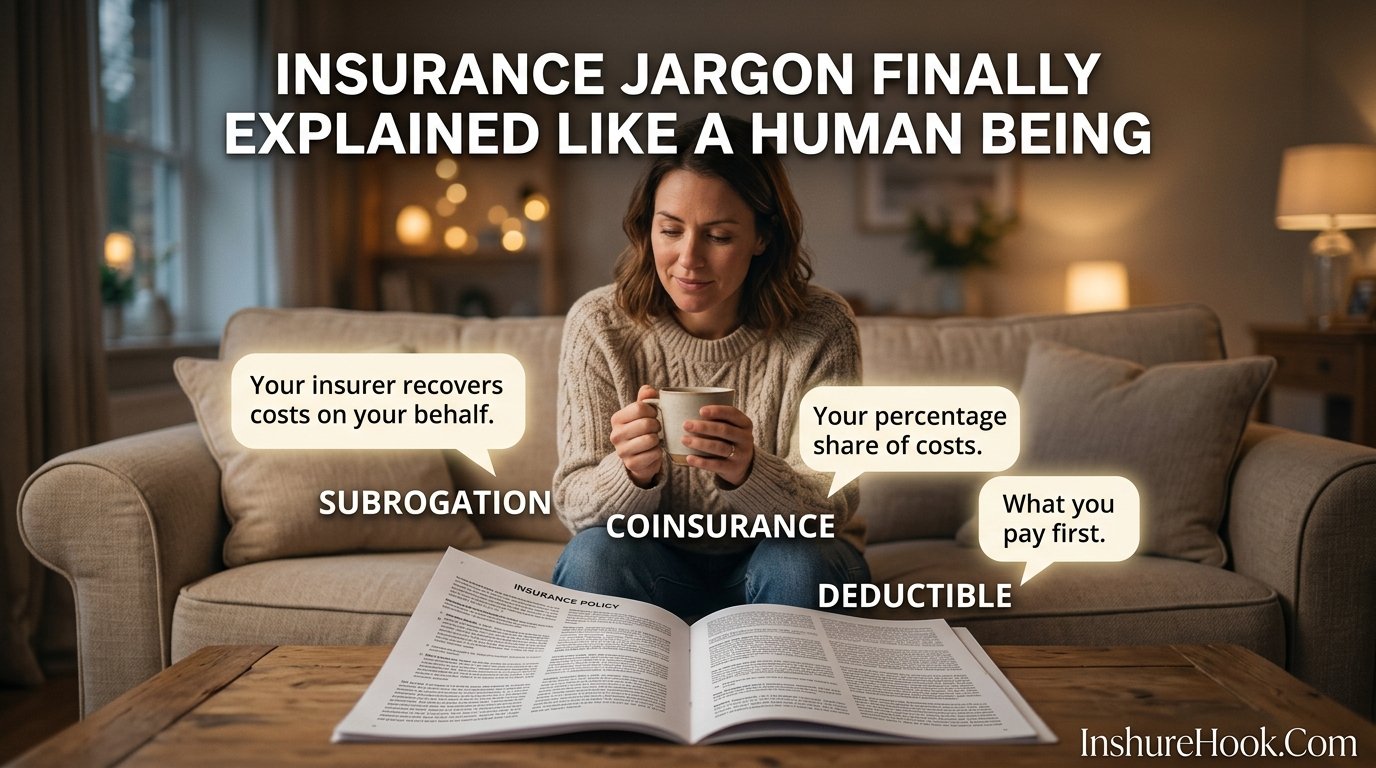
Insurance documents are full of words that sound technical and intimidating, even when the underlying concept is pretty simple once someone actually explains it. If you’ve ever stared at a policy document feeling completely lost, you’re not alone. This guide covers common insurance terms explained the way an actual person would explain them to you over coffee, not the way a legal document defines them.
Let’s go through the terms that show up most often, and what they actually mean for you.
Premium
Your premium is simply the amount you pay for your insurance coverage, whether that’s monthly, quarterly, or annually. It’s the cost of having the policy at all, separate from any costs you pay when you actually file a claim.
Think of it like a subscription fee. You pay it whether or not you ever use the service, in exchange for the protection being available if you need it.
Deductible
Your deductible is the amount you pay out of your own pocket before your insurance starts covering a claim. If you have a $1,000 deductible and $5,000 in covered damage, you pay the first $1,000 and your insurer covers the remaining $4,000.
Generally, higher deductibles mean lower premiums, and lower deductibles mean higher premiums. You’re essentially choosing how much risk you want to carry yourself versus how much you want to shift to the insurer.
Premium vs. Deductible: Why People Confuse These
This is genuinely one of the most common points of confusion. Your premium is what you pay regularly to maintain coverage. Your deductible is what you pay only when you actually file a claim. They’re not the same thing, and a low premium doesn’t tell you anything about how much you’d pay if something actually went wrong — that’s what the deductible (and coinsurance, covered next) determines.

Coinsurance
Coinsurance is your percentage share of costs after you’ve met your deductible. If your plan has 20% coinsurance, you pay 20% of covered costs, and your insurer pays the remaining 80%, until you reach your out-of-pocket maximum.
This shows up most commonly in health insurance, though it can appear in other policy types too. The insurance deductible vs copay guide breaks down exactly how deductibles, copays, and coinsurance work together across a typical plan year.
Out-of-Pocket Maximum
This is your annual cap on total cost-sharing. Once you’ve paid this amount in a calendar year — combining your deductible, copays, and coinsurance — your insurer covers 100% of additional covered costs for the rest of that year.
This is genuinely one of the most protective features of modern health insurance, since it prevents catastrophic, unlimited financial exposure even if you experience a major medical event.
Underwriting
Underwriting is the process an insurer uses to evaluate your risk before deciding whether to offer you coverage, and at what price. The underwriter looks at relevant factors — your health, driving record, property condition, or whatever’s applicable to the policy type — and uses that information to set your premium.
If you’ve ever wondered why your insurance quote seems specific to your exact situation rather than a flat rate everyone pays, underwriting is the reason.
Premium Loading and Risk Classification
Related to underwriting, this refers to how insurers categorize you into a risk tier — sometimes called a rate class — based on the underwriting process. Someone classified in a “preferred” tier (lower risk) pays less than someone in a “standard” or higher-risk tier, even for identical coverage amounts.
Beneficiary
Your beneficiary is the person or entity you’ve designated to receive the payout from your policy — most commonly used in the context of life insurance, where the beneficiary receives the death benefit. You can usually name a primary beneficiary and a contingent (backup) beneficiary in case the primary beneficiary has passed away or can’t be located.
Rider
A rider, sometimes called an endorsement, is an addition to your base policy that modifies your coverage — either expanding it, adding a specific benefit, or adjusting the terms in some way. Riders typically come at an additional cost, though some are included automatically depending on the insurer and policy type.
Exclusion
An exclusion is something your policy specifically does not cover. Every insurance policy has exclusions — situations or causes of loss that fall outside what you’re protected against. Reading the exclusions section of your policy is honestly just as important as reading what’s covered, since this is where surprise denials often originate.
Claim
A claim is your formal request to your insurer for payment under your policy, following a covered loss or event. Filing a claim starts the process where the insurer investigates, verifies the loss falls within your coverage, and issues payment (minus your deductible, if applicable).
Adjuster
An adjuster is the person who investigates and evaluates your claim on behalf of the insurance company. They assess the damage or loss, determine how much the policy should pay, and work through the claims process with you. It’s worth knowing that adjusters typically work for the insurer, even though they’re interacting directly with you — a public adjuster, by contrast, is someone you hire independently to represent your interests instead.
Subrogation
This one sounds more complicated than it is. Subrogation is the process where your insurer, after paying your claim, pursues the party actually responsible for causing your loss to recover what they paid out. If another driver hits your car and your insurer pays for your repairs, your insurer can then go after the at-fault driver’s insurer to recover that cost — and if successful, you typically get your deductible back too.

Grace Period
A grace period is the window of time after a missed premium payment during which your coverage remains active while you catch up on payment. This varies by policy type and state, but it typically ranges from a few days to a month, depending on the specific insurance type. The insurance grace period guide covers exactly how long grace periods typically last across different policy types and what happens if you don’t pay within that window.
Lapse
If you don’t pay your premium and the grace period expires without payment, your policy lapses — meaning coverage ends. A lapsed policy generally means you’re no longer protected, and reinstating it later, if possible at all, often requires new underwriting and sometimes a gap in your coverage history that can affect future premiums.
Declarations Page
Often called the “dec page,” this is the summary section at the front of your policy that lists the key details — your name, the property or vehicle insured, your coverage limits, your deductible, and your premium. If you ever need a quick reference for what your policy actually includes, the declarations page is the fastest place to look.
Actual Cash Value vs. Replacement Cost
These two terms describe different methods insurers use to calculate how much they’ll pay for damaged or lost property. Actual cash value accounts for depreciation — meaning an older item is worth less than a new one. Replacement cost pays what it would actually cost to buy a brand new equivalent item today, regardless of the original item’s age.
This distinction can mean a significant difference in your payout, especially for older belongings or an aging home.
| Term | Plain English Meaning |
|---|---|
| Premium | What you pay to have the policy |
| Deductible | What you pay before insurance kicks in |
| Coinsurance | Your percentage share after the deductible |
| Underwriting | How the insurer evaluates and prices your risk |
| Subrogation | Insurer recovering costs from whoever caused your loss |
| Lapse | Coverage ending due to non-payment |

Named Peril vs. Open Peril (All-Risk) Policies
A named peril policy only covers the specific causes of loss explicitly listed in the policy — if it’s not named, it’s not covered. An open peril (sometimes called “all-risk”) policy covers everything except what’s specifically excluded, which generally provides broader protection.
Most standard homeowners policies actually combine both approaches — open peril for the dwelling structure, named peril for personal property — which is exactly the kind of detail that catches people off guard if they assume their entire policy works the same way throughout.
Endorsement
This term gets used in two different but related ways. As mentioned earlier, it can mean the same thing as a rider — an addition that modifies your policy. It can also refer more broadly to any official change made to your policy after it’s issued, including changes to coverage limits, added drivers, or updated property information.
Pros and Cons of Understanding Insurance Terminology
Pros:
- Helps you make informed decisions when comparing policies or quotes
- Reduces the chance of unpleasant surprises during a claim
- Allows you to ask more specific, useful questions to your agent or insurer
- Makes reading your actual policy documents far less intimidating
Cons:
- Takes some upfront time investment to learn
- Terminology can vary slightly between insurers or policy types
- Some terms have technical legal definitions that go beyond a simple explanation
FAQs
A lot of insurance terminology originated from legal and actuarial contexts where precision matters for contractual purposes. While this language is necessary for the legal structure of policies, it’s admittedly not designed with everyday readability in mind, which is exactly why resources translating these terms into plain English are useful.
Yes. Your policy is the entire contract — the full document outlining all terms, conditions, and provisions. Coverage refers to the specific protections within that policy, like liability coverage, collision coverage, or personal property coverage. A single policy typically contains multiple types of coverage bundled together.
An agent typically represents one or a small number of specific insurance companies and sells their products. A broker represents you, the buyer, and can shop multiple insurers to find coverage that fits your needs, rather than being tied to one company’s offerings.
Not quite. A binder is a temporary proof of coverage, often issued quickly while your full policy is being finalized — commonly used when you need to show proof of insurance before closing on a home, for example. The full policy document follows shortly after and becomes the actual governing contract.
This refers to providing false or significantly inaccurate information on your insurance application — whether intentionally or through a significant oversight — that affects how the insurer assessed your risk. If discovered, especially during a claim, it can result in a denied claim or even a voided policy, which is exactly why answering application questions accurately matters more than it might seem at the time.
